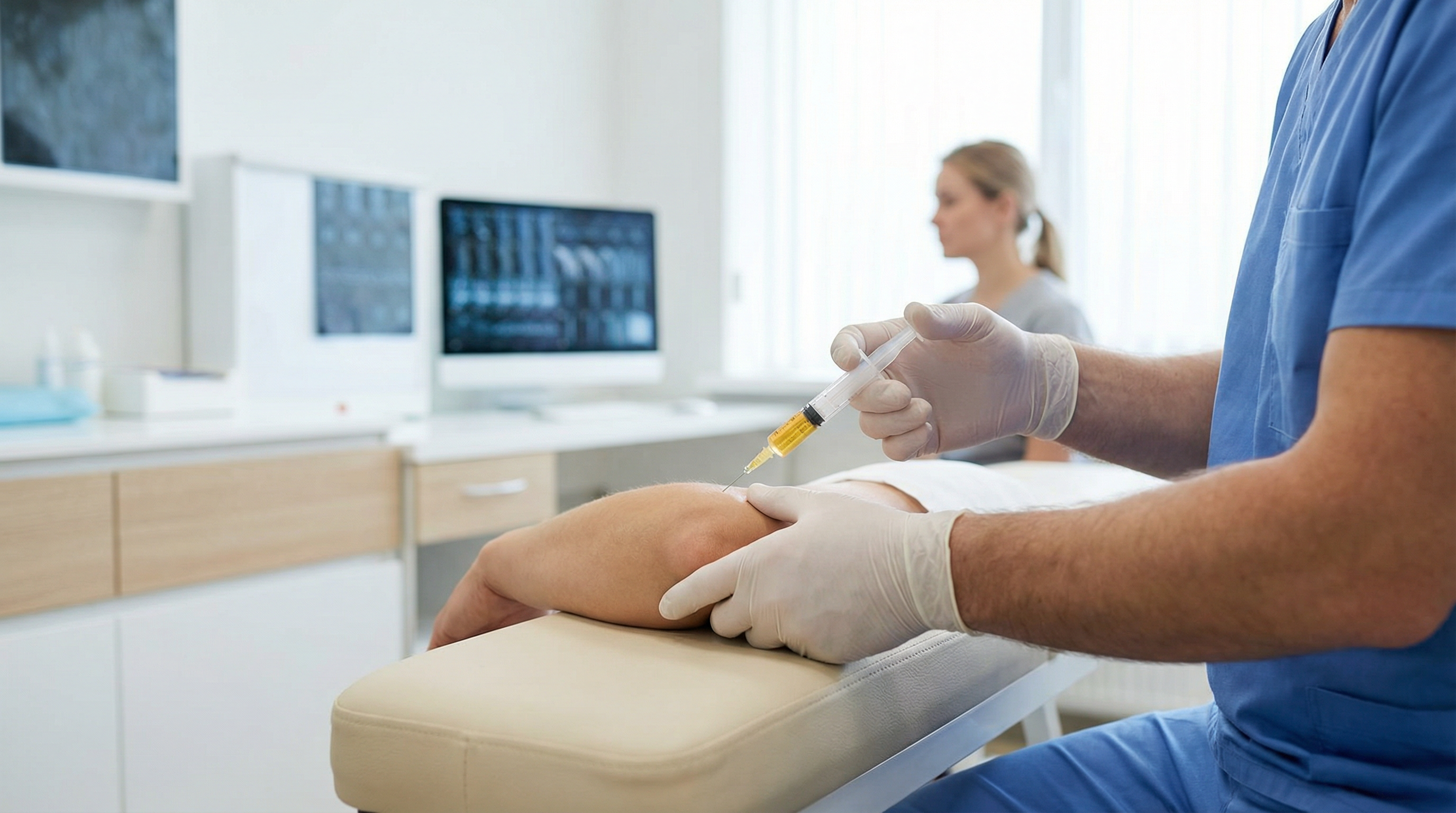
Learn about PRP injection therapy for elbow pain and injuries. Discover how platelet-rich plasma treatment can help heal elbow conditions without surgery.
The elbow is one of the most overused joints in the upper body. Tendons that attach to the inner and outer sides of the elbow are under constant stress from repetitive gripping, lifting, and swinging, and once they degenerate, they rarely heal on their own. PRP (Platelet-Rich Plasma) therapy delivers concentrated growth factors directly into degenerating elbow tendons and inflamed tissues, offering a biologically active alternative to cortisone for patients with persistent elbow pain.
PRP treatment for elbow conditions
Elbow Conditions Treated With PRP
PRP is applied to several distinct elbow conditions, each targeting a different tendon or tissue structure. The most common are lateral epicondylitis (tennis elbow), medial epicondylitis (golfer's elbow), and olecranon bursitis.
Lateral epicondylitis (tennis elbow) is the most common elbow condition treated with PRP. The extensor tendons that attach to the lateral epicondyle, the bony bump on the outer elbow, undergo degenerative change from repetitive gripping and wrist extension. The result is chronic outer elbow pain that responds poorly to rest and cortisone over time. PRP injected into the degenerative tendon zone delivers growth factors that stimulate collagen production and tissue repair.
Medial epicondylitis (golfer's elbow) involves the same degenerative process on the inner elbow, where the flexor-pronator tendons attach to the medial epicondyle. Less common than tennis elbow but equally stubborn, it causes inner elbow and forearm pain that limits gripping and throwing activities. PRP targets the degeneration at the flexor-pronator origin that drives this condition.
Olecranon bursitis involves inflammation of the fluid-filled sac at the tip of the elbow. When chronic and non-infectious, PRP injection can reduce the persistent inflammation and fibrotic thickening that drive ongoing pain and swelling, though evidence for this specific application remains limited compared to epicondylitis.
Condition
Injection Target
Evidence Level
Typical Protocol
Best Candidates
Lateral Epicondylitis (Tennis Elbow)
Extensor tendon origin at lateral epicondyle
Strong (11-RCT meta-analysis, 730 patients)
1–2 injections under ultrasound guidance
Chronic (3+ months); failed PT/cortisone
Medial Epicondylitis (Golfer's Elbow)
Flexor-pronator tendon origin at medial epicondyle
Moderate (systematic review, comparable to surgery)
PRP is prepared by drawing a small blood sample and concentrating the platelet-rich fraction through centrifugation. The resulting preparation, rich in growth factors including PDGF, TGF-β, IGF-1, and VEGF, is injected precisely into the degenerative tendon zone identified on diagnostic ultrasound or MRI.
Ultrasound guidance is standard for elbow PRP injections. The degenerative tendon zone is typically visible as a hypoechoic (dark) region on ultrasound imaging. Injecting directly into this zone, rather than using surface landmarks alone, significantly improves outcomes. The growth factors activate tenocytes (tendon cells) to produce new collagen, clear inflammatory debris, and restore normal tissue architecture.
Ultrasound-guided PRP injection for elbow tendinopathy
For medial epicondylitis, a 2022 systematic review comparing PRP to surgical intervention found that PRP produced outcomes equivalent to surgery in relieving pain and restoring function, with both groups achieving full range of motion and pain-free status. The authors concluded that PRP is a viable non-surgical alternative for medial epicondylitis that fails conservative care.
PRP vs. Cortisone for Elbow Conditions
Cortisone injections are among the most common treatments for both tennis elbow and golfer's elbow. They reduce pain quickly, often within 1–2 weeks, making them appealing for patients who need fast relief. However, the benefit is consistently short-lived. Multiple studies show that cortisone outperforms PRP at 4–8 weeks but is significantly outperformed by PRP at 6 months and beyond.
More critically, repeated cortisone injections into degenerating tendons carry a documented risk of further tendon damage. The extensor and flexor tendons of the elbow are already compromised in epicondylitis, cortisone suppresses inflammation without addressing the degeneration, and repeated injections can accelerate tissue breakdown. For patients with chronic epicondylitis who have had multiple cortisone injections with diminishing returns, PRP is a more biologically appropriate treatment.
Who Is a Good Candidate for Elbow PRP?
PRP is best suited for patients with chronic elbow pain (3+ months) that has not responded adequately to conservative treatment, physical therapy, activity modification, bracing, NSAIDs, or prior cortisone injections. Good candidates have imaging-confirmed tendon degeneration at the lateral or medial epicondyle, visible on diagnostic ultrasound or MRI as a hypoechoic or signal-changed region. PRP is generally not the first choice for acute injuries or mild, early-stage tendinopathy that has not been through a structured loading program.
What to Expect
Elbow PRP is performed as an outpatient procedure under ultrasound guidance. Expect 2–5 days of increased elbow soreness after the injection, this is a normal part of the inflammatory healing response. Most patients resume light activity within 1–2 days; heavy gripping, lifting, or racket sports should be restricted for 2–3 weeks. Meaningful improvement in pain and function typically begins at 4–8 weeks. Physical therapy, particularly an eccentric and isometric tendon-loading program, is strongly recommended alongside PRP to maximize tissue remodeling and prevent recurrence.
1. Xu Y, Li T, Wang L, Yao L, Li J, Tang X. Platelet-Rich Plasma Has Better Results for Long-term Functional Improvement and Pain Relief for Lateral Epicondylitis: A Systematic Review and Meta-analysis of Randomized Controlled Trials. Am J Sports Med. 2024;52(10):2646-2656. PMID: 38357713.
2. Alzahrani WM. Platelet-Rich Plasma Injections as an Alternative to Surgery in Treating Patients With Medial Epicondylitis: A Systematic Review. Cureus. 2022;14(8):e28378. PMID: 36171858.
This content is for educational purposes only and does not constitute medical advice. Consult a qualified healthcare provider before starting any treatment.
Frequently Asked Questions
Find an Elbow PRP Specialist Near You
Browse our directory of verified providers who offer PRP injections for tennis elbow, golfer's elbow, and other elbow conditions.