Explore how PRP injections can treat golfer's elbow. Learn about platelet-rich plasma therapy benefits, recovery, and results for golfer's elbow.
Golfer's elbow, medial epicondylitis, is a tendinopathy of the flexor-pronator muscle origin at the medial epicondyle. Like its lateral counterpart tennis elbow, it involves chronic degeneration of tendon tissue rather than simple inflammation, which explains why cortisone provides only temporary relief. PRP (Platelet-Rich Plasma) targets the underlying tendon pathology directly. A 2024 meta-analysis of 11 randomized controlled trials found PRP produces significantly better pain relief and functional outcomes than corticosteroids at six months and beyond, with cortisone winning only the first two months.
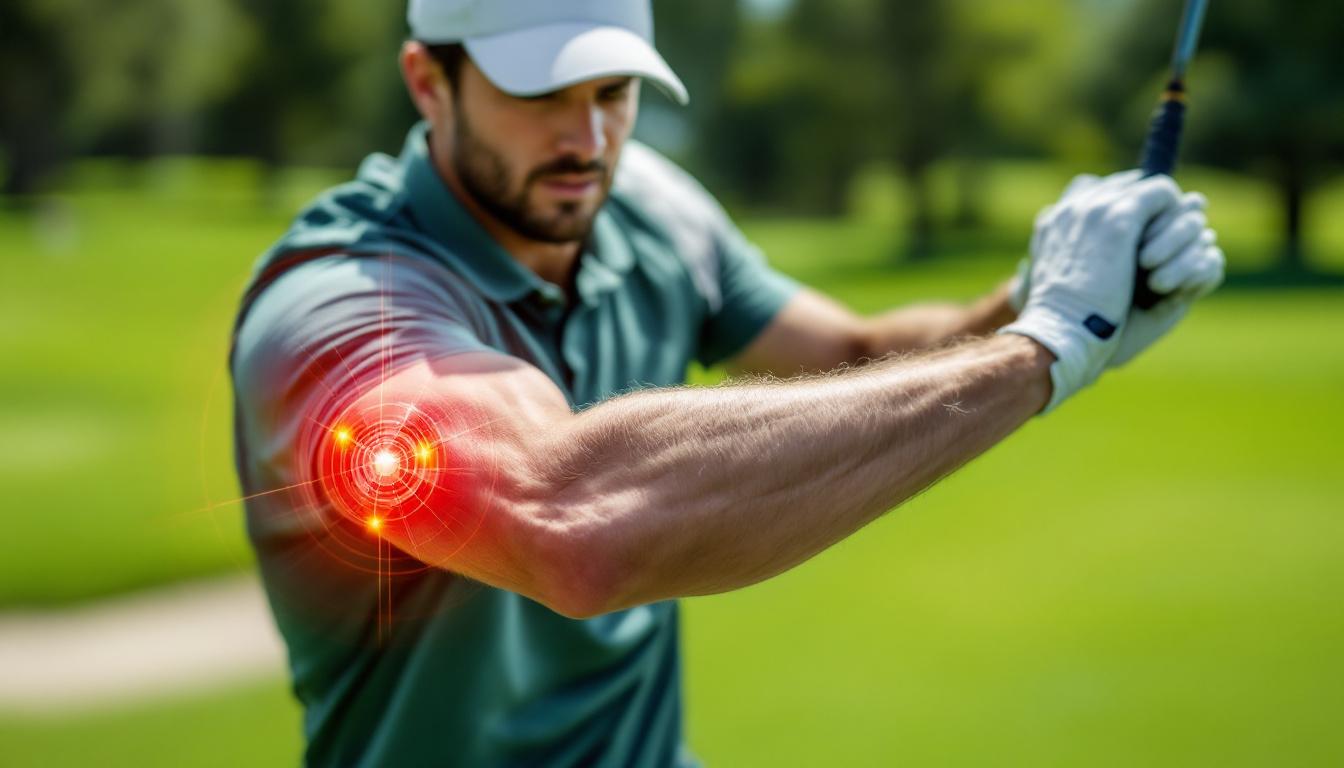
Golfer's elbow (medial epicondylitis) pain and PRP treatment
What Is Golfer's Elbow?
The medial epicondyle is the bony prominence on the inner side of the elbow. The tendons of the forearm flexors and the pronator teres muscle attach here at a shared origin called the common flexor tendon. Repetitive gripping, wrist flexion, and forearm rotation overload this attachment point, leading to micro-tears and failed healing. Over time, the tendon undergoes degenerative change, a process called tendinosis, rather than acute inflammation.
The result is medial elbow pain that worsens with gripping, lifting, wrist flexion, and activities that load the inner forearm. It is common in golfers (particularly during the swing), climbers, baseball players, and anyone who performs repetitive gripping tasks. Despite the name, golfer's elbow occurs in many non-golfers, manual workers, racket sport players, and overhead athletes all develop it regularly.
Conservative management, activity modification, physical therapy focusing on eccentric loading, and NSAIDs, resolves symptoms in most patients given enough time. Corticosteroid injections reduce pain quickly but do not address the degenerative tendon pathology, and their benefit typically fades within 4–12 weeks. For patients with chronic medial epicondylitis who have not responded to conservative care, PRP is a biologically rational next step.
Application
Injection Target
Evidence Level
Typical Protocol
Best Candidates
Medial Epicondylitis (Golfer's Elbow)
Common flexor tendon origin at medial epicondyle under ultrasound guidance
PRP for medial epicondylitis is injected into the degenerative tissue at the common flexor tendon origin, typically under ultrasound guidance. The concentrated platelet growth factors, PDGF, TGF-β, IGF-1, and VEGF, are released directly into the tendon tissue, where they activate tenocytes to produce new collagen, stimulate angiogenesis, and shift the local biology from a degenerative to a regenerative state.
Ultrasound guidance allows the provider to visualize the medial epicondyle and the common flexor tendon origin in real time, identify hypoechoic (degenerated) areas within the tendon, and place the needle precisely at the site of pathology. Needling the tendon tissue as part of the injection, a technique called tendon fenestration, may augment the healing response by disrupting degenerative tissue and stimulating a fresh healing cascade.
The goal is structural tendon repair, not temporary pain suppression. This explains the slower onset compared to cortisone: tendon regeneration takes weeks, not days. But the biological changes that PRP initiates are durable rather than transient, which is why outcomes at 6 months and beyond consistently favor PRP over corticosteroids.
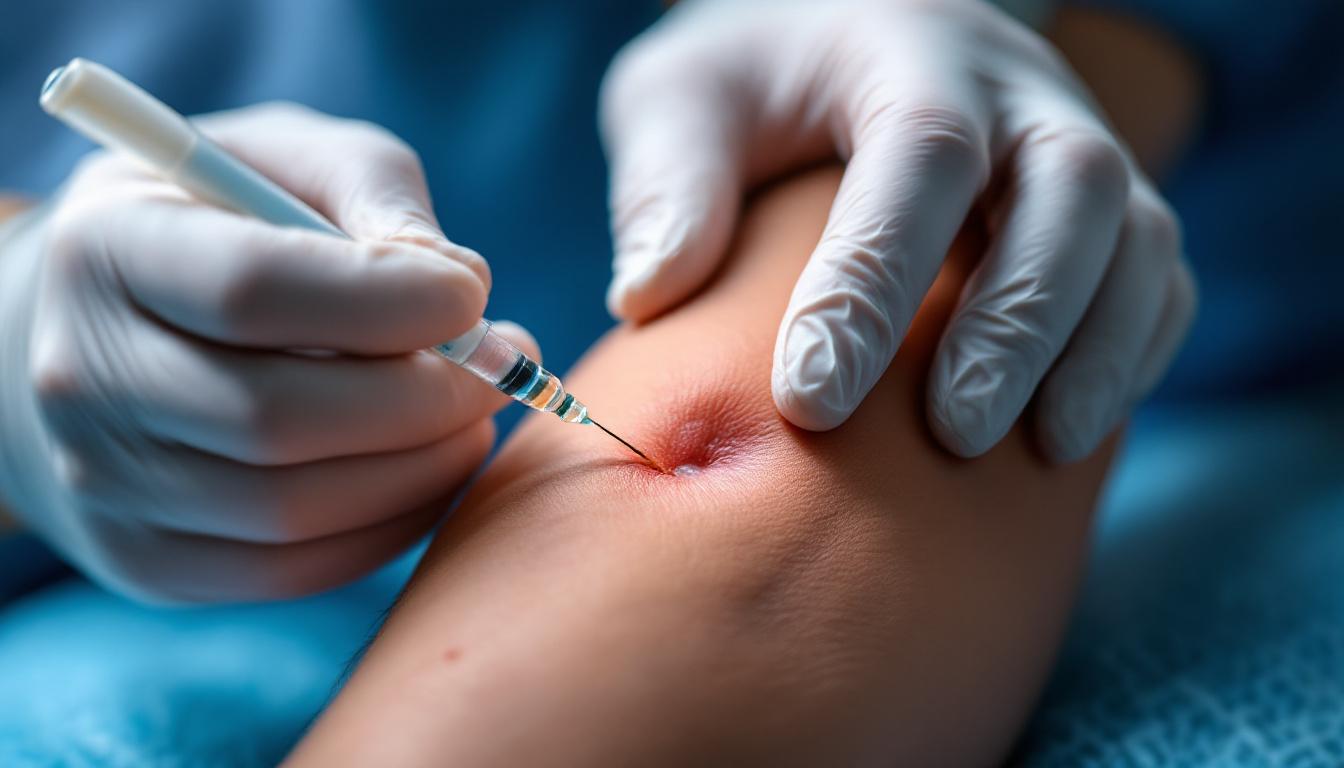
PRP injection into the common flexor tendon for golfer's elbow treatment
What the Research Shows
Note: the majority of high-quality randomized evidence for PRP in elbow tendinopathy comes from lateral epicondylitis (tennis elbow) research. Golfer's elbow involves the same tendinopathy pathology at the medial epicondyle, and the PRP evidence from lateral epicondylitis studies is considered directly applicable. Specific medial epicondylitis PRP RCTs are limited.
A 2024 systematic review and meta-analysis of 11 randomized controlled trials involving 730 patients with elbow epicondylitis1, published in the American Journal of Sports Medicine, compared PRP versus corticosteroid injections across short-term (<2 months), medium-term (2–6 months), and long-term (≥6 months) time points. Corticosteroids produced better pain and function scores short-term. PRP produced significantly better pain relief and functional scores at long-term follow-up (VAS, DASH, Mayo Elbow Performance Scores). No significant differences were found at medium-term follow-up. The authors concluded that corticosteroids are preferred for immediate relief while PRP offers superior sustained outcomes.
A 2022 systematic review specifically examining PRP for medial epicondylitis3, published in Cureus, found that PRP injections produced outcomes comparable to surgery in the two studies meeting inclusion criteria. The authors concluded PRP is a promising treatment option for medial epicondylitis, particularly as an alternative to surgery for patients who want to avoid operative intervention.
The consistent message across these studies: PRP is not the fastest-acting option for elbow tendinopathy. Cortisone wins in the first 1–2 months. But for patients who want durable improvement, or who have already had cortisone without lasting benefit, PRP is the better long-term choice.
PRP vs. Cortisone for Golfer's Elbow
Corticosteroid injections are the standard first-line injection for medial epicondylitis. They reduce inflammation quickly, provide pain relief within 1–2 weeks, and make physical therapy more manageable. For acute flares or patients who need to return to activity quickly, cortisone is often the right first step. The limitation is durability: the anti-inflammatory effect fades within weeks, and the underlying tendon degeneration remains unaddressed.
PRP works more slowly, meaningful improvement typically begins at 4–8 weeks, but targets the degenerative tissue directly. Repeated cortisone injections carry documented risks of tendon weakening and further structural damage over time. PRP does not carry these risks. For patients who have had one or two cortisone injections without lasting benefit, or who want to avoid repeat steroid exposure, PRP is a biologically distinct and evidence-supported next step.
Who Is a Good Candidate?
PRP is most appropriate for patients with chronic medial epicondylitis (symptoms persisting beyond 3–6 months) who have completed a course of physical therapy, particularly eccentric loading exercises, and who have had cortisone without lasting benefit. Ultrasound confirmation of tendinopathy (hypoechoic areas, tendon thickening, or calcification) at the common flexor origin is helpful before proceeding with PRP.
Patients in an acute flare who haven't yet tried conservative care or cortisone are generally better served by first-line treatments. Patients with ulnar nerve involvement, tingling or numbness in the ring and little fingers, require careful evaluation before any injection, as the ulnar nerve runs in close proximity to the medial epicondyle. Patients with complete tendon tears are surgical candidates and should be evaluated accordingly.
What to Expect
Golfer's elbow PRP is performed as an outpatient procedure under ultrasound guidance. A blood draw is centrifuged to prepare the platelet-rich fraction, which is then injected into the degenerative area at the common flexor tendon origin with real-time ultrasound confirming accurate placement. The procedure takes approximately 20–30 minutes. Expect 2–5 days of increased medial elbow soreness, a normal inflammatory healing response.
Gripping activity and forearm loading should be limited for 1–2 weeks. A graduated return to activity is guided by symptoms. Meaningful improvement in elbow pain and grip strength typically begins at 4–8 weeks. Most protocols start with one injection and reassess at 6–8 weeks. A second injection is considered for partial responders, particularly those with significant tendon degeneration on ultrasound.
Physical therapy, specifically eccentric and progressive loading of the flexor-pronator muscle group, is essential alongside PRP. The biological changes PRP initiates need to be paired with controlled tendon loading to remodel the new collagen and restore full tendon strength.
1. Xu Y, Chen L, Zheng Y, Wang T, Ye X, Li Y. Platelet-rich plasma vs corticosteroid injections for elbow epicondylitis: a systematic review and meta-analysis. Am J Sports Med. 2024;52(5):1344-1356. doi:10.1177/03635465231213537. PMID: 38357713.
2. Hohmann E, Glatt V, Tetsworth K, Keough N, Rossi MJ. Corticosteroid injections are superior to platelet-rich plasma injections at one month but platelet-rich plasma injections are superior at 3 and 6 months for lateral epicondylitis. J Shoulder Elbow Surg. 2023;32(9):1949-1960. doi:10.1016/j.jse.2023.04.010. PMID: 37247780.
3. Alzahrani WM. Platelet-Rich Plasma Injections as an Alternative to Surgery in Treating Patients With Medial Epicondylitis: A Systematic Review. Cureus. 2022;14(9):e29698. doi:10.7759/cureus.29698. PMID: 36171858.
This content is for educational purposes only and does not constitute medical advice. Consult a qualified healthcare provider before starting any treatment.
Frequently Asked Questions
Find a Golfer's Elbow PRP Specialist Near You
Browse our directory of verified providers who offer PRP injections for medial epicondylitis and other elbow conditions.