Explore how PRP injections can treat ankle sprains. Learn about platelet-rich plasma therapy benefits, recovery, and results for ankle sprains.
Ankle sprains are the most common musculoskeletal injury in sports and daily activity, but not all of them heal cleanly. When ligament damage goes beyond the acute phase, incomplete healing can progress to chronic lateral ankle instability, persistent pain, and repeated sprains. PRP (Platelet-Rich Plasma) therapy is used for both acute sprains where recovery is stalling and chronic instability where conservative care has fallen short, delivering concentrated growth factors directly into the injured ligament tissue to stimulate repair.
The ATFL is the most commonly injured lateral ankle ligament, involved in roughly 70% of ankle sprains
Ankle Sprains and Lateral Ankle Instability
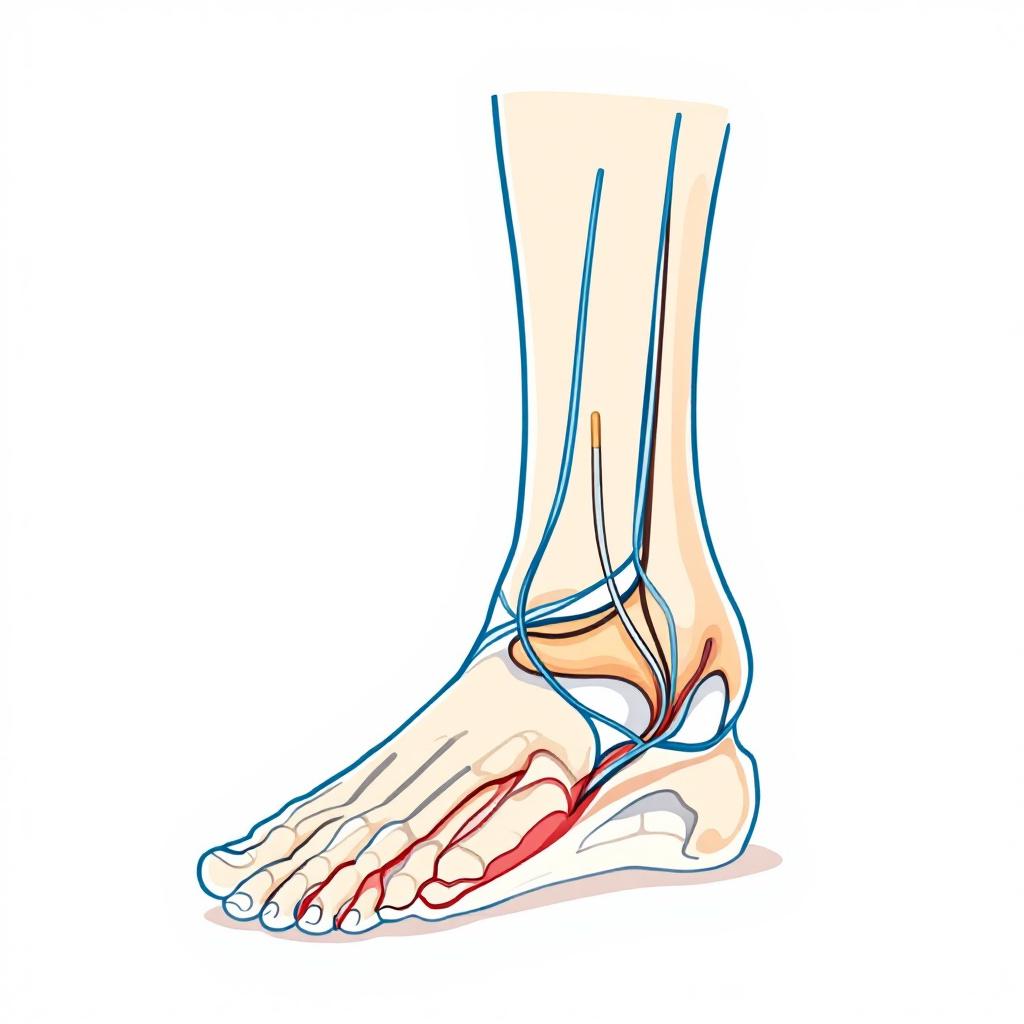
The lateral ankle ligaments, the anterior talofibular ligament (ATFL), calcaneofibular ligament (CFL), and posterior talofibular ligament (PCFL), stabilize the ankle against excessive inversion. The ATFL is the most commonly injured, involved in roughly 70% of all ankle sprains.
Ankle sprains are graded by severity. Grade 1 involves mild stretching with no ligament tear. Grade 2 is a partial tear with some joint laxity. Grade 3 is a complete rupture with significant instability. Most acute sprains resolve with conservative care, rest, ice, compression, elevation, and physical therapy, but 20–40% of patients develop chronic lateral ankle instability, where the ligament fails to heal fully and the ankle remains unstable.
PRP injected into the ATFL or the lateral ankle ligament complex delivers growth factors, PDGF, TGF-β, IGF-1, and VEGF, that activate fibroblasts and tenocytes to produce new collagen. The goal is to support ligament healing that hasn't occurred naturally and reduce the chronic low-grade inflammation driving ongoing symptoms.
Application
Injury Type
Evidence Level
Typical Protocol
Best Candidates
Acute lateral ankle sprain
Grade 2–3 partial ligament tear
Moderate (2025 systematic review, 4 studies; Level B)
1 injection under ultrasound guidance
Failed conservative care at 6–8 weeks; athletes; high-demand patients
A 2025 systematic review and meta-analysis of 4 studies on PRP for ankle sprain1 found that PRP provided superior short-term pain relief, better functional outcomes, and earlier return to activity and sport compared to control groups. The safety profile was excellent, no adverse events were reported across the included studies. The benefit was most pronounced in the early recovery phase, with both groups showing comparable scores at longer-term follow-up.
A 2024 critically appraised topic evaluating 3 randomized controlled trials2 found that PRP reduces pain and improves function 5 to 8 weeks after lateral ankle sprain, rated as Level B (moderate) evidence. The authors noted that while high-quality evidence supports PRP in other musculoskeletal conditions, the ankle sprain research base, though promising, needs larger trials.
For chronic lateral ankle instability, a 2024 retrospective case series of 47 patients3 found statistically significant improvement in CAIT and Karlsson functional scores at 3 months following a series of PRP injections into the ATFL and joint. Baseline scores nearly doubled in both measures, with no adverse events reported. The authors concluded the results support a randomized controlled trial to further validate PRP for this indication.
PRP vs. Cortisone for Ankle Sprains
Cortisone injections are sometimes used for ankle sprains to reduce acute inflammation, but their role is limited. For the lateral ankle ligaments, which need structural healing, not just inflammation suppression, cortisone carries a risk of weakening the already-damaged tissue, and there is no evidence that it accelerates ligament repair.
PRP takes a different approach. Rather than suppressing inflammation, it delivers the growth factors that drive tissue repair. For patients whose recovery has stalled after 6–8 weeks of conservative care, PRP is the biologically appropriate intervention, addressing the underlying healing deficit rather than masking symptoms.
Proprioceptive training and progressive loading are essential alongside PRP for full ankle recovery
Who Is a Good Candidate?
PRP is not the first-line treatment for most ankle sprains, the majority of grade 1 and 2 sprains heal well with RICE protocol and physical therapy. PRP becomes relevant for patients who meet one or more of the following criteria:
Healing is incomplete at 6–8 weeks despite compliance with conservative care
MRI confirms ligament signal change or partial tear
The patient is an athlete needing to accelerate return to sport
The patient has chronic lateral ankle instability with repeated episodes of giving way
Grade 3 complete ligament ruptures with significant mechanical instability typically require surgical evaluation, PRP is used in this context as a surgical adjunct during ligament repair, not as a standalone non-surgical treatment. Patients with active infection, clotting disorders, or recent corticosteroid use at the injection site are not candidates.
What to Expect
Ankle PRP is performed as an outpatient procedure under ultrasound guidance. The ATFL and lateral ankle ligament structures are superficial and well-visualized by ultrasound, allowing precise placement into the damaged ligament. Expect 2–5 days of increased local soreness after the injection, a normal healing response.
Weight-bearing is generally permitted the same day with protective bracing. High-impact activity (running, jumping, cutting) should be restricted for 1–2 weeks. Meaningful improvement typically begins at 4–6 weeks. One injection is standard for acute cases, with a second considered at 6–8 weeks for chronic instability or incomplete responders.
Physical therapy, including proprioceptive training, peroneal strengthening, and progressive balance work, is essential alongside PRP. Ligament healing without neuromuscular rehabilitation leads to incomplete recovery regardless of biological support.
1. Banerjee S, Mishra S, Rajnish RK, Yadav SK, Gupta S, Elhence A. Efficacy of Autologous Platelet-Rich Plasma for the Treatment of Ankle Sprain: A Systematic Review of Literature with Limited Meta-Analysis. Indian J Orthop. 2025;59(7):910-919. doi:10.1007/s43465-025-01418-1. PMID: 40657216.
2. Frey E, Brown CD, Tripp B. Effectiveness of Platelet-Rich Plasma in Reducing Pain and Increasing Function After Acute Lateral Ankle Sprain: A Critically Appraised Topic. J Sport Rehabil. 2024;33(7):558-561. doi:10.1123/jsr.2023-0425. PMID: 38996449.
3. Medina-Porqueres I, Martin-Garcia P, Sanz-De-Diego S, et al. Platelet-Rich Plasma Injections in Chronic Lateral Ankle Instability: A Case Series. Biomedicines. 2024;12(5):963. doi:10.3390/biomedicines12050963. PMID: 38790925.
This content is for educational purposes only and does not constitute medical advice. Consult a qualified healthcare provider before starting any treatment.
Frequently Asked Questions
Find an Ankle PRP Specialist Near You
Browse our directory of verified providers who offer PRP injections for ankle sprains, chronic instability, and other foot and ankle conditions.