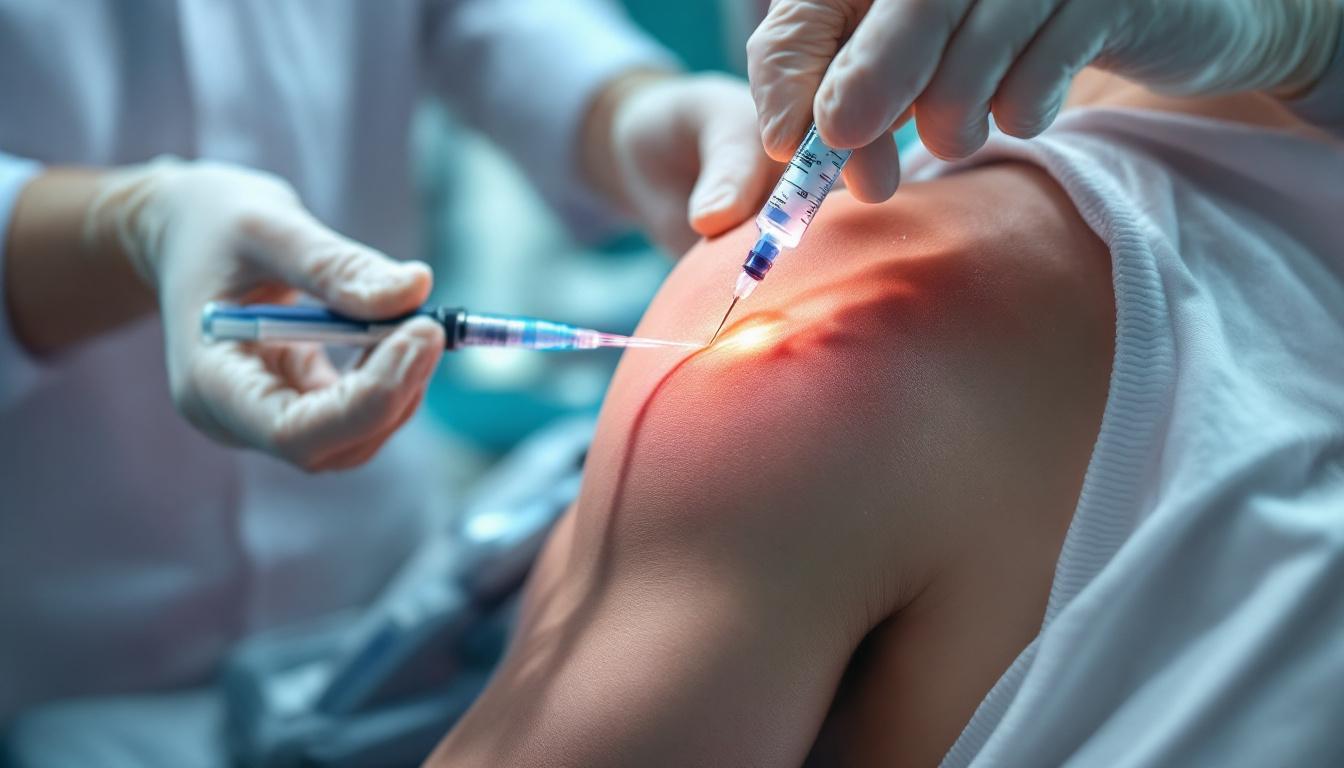
Explore how PRP injections can treat frozen shoulder. Learn about platelet-rich plasma therapy benefits, recovery, and results for frozen shoulder.
Frozen shoulder, adhesive capsulitis, causes progressive pain and stiffness that can rob the shoulder of nearly all motion for months to years. Corticosteroid injections are the standard first-line treatment, but their benefit fades, and repeated injections carry tissue risks. PRP (Platelet-Rich Plasma) therapy has emerged as a more durable alternative: a 2024 meta-analysis of 14 randomized controlled trials found PRP outperforms corticosteroids on pain and function at late follow-up, with a better safety profile.
Frozen shoulder (adhesive capsulitis) examination and PRP treatment
What Is Frozen Shoulder?
Adhesive capsulitis is a condition in which the shoulder joint capsule becomes inflamed, thickened, and contracted. Scar tissue (adhesions) forms between the capsule layers, progressively restricting range of motion, particularly external rotation and abduction. Pain is often severe in the early (freezing) stage, while stiffness peaks in the frozen stage and gradually resolves in the thawing stage. The full cycle typically spans 1–3 years.
The condition is most common in adults between 40 and 60 years old and is significantly more prevalent in people with diabetes, thyroid disorders, and Parkinson's disease. The exact trigger varies, some cases follow trauma or surgery, others arise without clear cause (primary or idiopathic adhesive capsulitis). Either way, the structural problem is the same: a contracted, inflamed capsule.
Standard treatment progresses from NSAIDs and physical therapy through corticosteroid injections, and, for refractory cases, hydrodilation (distension arthrography), manipulation under anesthesia, or arthroscopic capsular release. Cortisone injections are effective for early-stage pain but provide diminishing returns on motion and long-term function. Their effect typically fades by 6–12 weeks, and repeated injections are limited by cartilage and soft-tissue risks.
Application
Injection Target
Evidence Level
Typical Protocol
Best Candidates
Frozen Shoulder (Adhesive Capsulitis)
Glenohumeral joint (intra-articular) under ultrasound guidance
PRP for frozen shoulder is injected into the glenohumeral joint and/or the subacromial space under ultrasound guidance. The platelet-derived growth factors, PDGF, TGF-β, IGF-1, and VEGF, target the inflammatory and fibrotic processes driving capsular contraction. TGF-β in particular has been studied for its role in modulating fibroblast activity; by delivering it at concentrated levels, PRP may reduce the fibrotic adhesion formation that stiffens the capsule.
Unlike cortisone, which suppresses inflammation transiently, PRP acts at the tissue level. The goal is to shift the capsular microenvironment from chronic inflammation toward tissue remodeling, gradually restoring capsular compliance and shoulder motion. The onset is slower than cortisone, but the benefit extends significantly further, particularly past the 24-week mark where corticosteroids have typically lost their edge.
Ultrasound guidance is standard for glenohumeral injection. The posterior approach to the joint space is well-visualized on ultrasound and allows accurate intra-articular delivery. The subacromial bursa may also be targeted in cases with significant bursitis component. Accurate placement matters, malpositioning reduces outcomes for any injectate.
PRP injection procedure for frozen shoulder under ultrasound guidance
What the Research Shows
A 2024 systematic review and meta-analysis of 14 randomized controlled trials involving 1,024 patients1, published in BMC Musculoskeletal Disorders, provides the strongest current evidence for PRP in frozen shoulder. At late follow-up (≥24 weeks), PRP produced significantly greater pain reduction than corticosteroids (MD = −1.26 on VAS; 95% CI −1.79 to −0.73; P < 0.00001). Functional improvements were consistent across multiple validated scales: UCLA shoulder score (MD = 3.31), DASH disability score (MD = −4.94), and total SPADI score (MD = −16.87). Range of motion improvements were clinically meaningful, active flexion gained 12.70°, abduction 13.54°, and external rotation 10.50° more in PRP-treated patients at follow-up. The authors concluded PRP was more durable and safer than corticosteroids for frozen shoulder.
A 2023 systematic review of 19 studies involving 592 PRP-treated patients and 671 controls2, published in Cureus, found that 93% of range-of-motion comparisons favored PRP at longest follow-up. All studies recorded markedly decreased VAS pain scores after PRP injection compared to baseline, and DASH and SPADI functional scores improved consistently. No adverse events were reported across the included studies. The authors concluded PRP offers a promising treatment option for adhesive capsulitis with a favorable safety profile.
The pattern across these studies is consistent: cortisone provides faster early relief, but PRP produces more durable improvement, especially beyond 6 months. For patients in the frozen or late-freezing stage who have had cortisone injections without lasting benefit, the evidence supports PRP as the stronger long-term option.
PRP vs. Cortisone for Frozen Shoulder
Corticosteroid injections are first-line for frozen shoulder because they work quickly, most patients experience meaningful pain relief within 1–2 weeks. For patients in the acute freezing stage, cortisone is often the right first step: it controls severe pain, makes physical therapy tolerable, and speeds early recovery. The problem is durability. Cortisone's effect on frozen shoulder is largely anti-inflammatory; it doesn't address the fibrotic capsular contraction that limits motion, and its benefit typically fades by 12 weeks.
PRP works more slowly, meaningful improvement typically begins at 4–8 weeks, but its action at the tissue level means the benefit continues to accumulate. By 6 months, PRP-treated patients consistently show better pain scores, more range of motion, and better function than corticosteroid-treated patients in head-to-head comparisons. For patients who have had one or two cortisone injections without satisfactory lasting relief, PRP is the evidence-supported next step before considering more invasive procedures.
Who Is a Good Candidate?
PRP is most appropriate for patients with stage 2 (frozen) or late stage 1 (freezing) adhesive capsulitis who have had cortisone injections without lasting improvement, or who want a more durable non-surgical option. Patients in whom corticosteroids are contraindicated, diabetes, immunosuppression, prior adverse reactions, are also strong candidates, given PRP's favorable safety profile compared to repeated steroid use.
PRP is less likely to produce dramatic benefit in very early stage 1 disease, where acute inflammation may still respond well to cortisone and physical therapy alone. It is also not a substitute for manipulation under anesthesia or arthroscopic release in severe refractory cases where significant mechanical adhesions are preventing progress. The best outcomes are seen in patients with moderate-to-significant capsular restriction who are committed to physical therapy alongside injection treatment.
What to Expect
Frozen shoulder PRP is performed as an outpatient procedure under ultrasound guidance. A blood draw is centrifuged to prepare the PRP, which is then injected into the glenohumeral joint, typically via the posterior portal, with the shoulder joint position confirmed by ultrasound. The procedure takes approximately 30–45 minutes. Expect 2–5 days of increased shoulder soreness, a normal inflammatory healing response.
Light use of the arm is generally permitted within a few days. Physical therapy focusing on pendulum exercises, passive stretching, and progressive range-of-motion work should begin within 1–2 weeks of injection, the tissue-level changes PRP initiates need to be paired with mechanical mobilization to restore full capsular compliance. Meaningful improvement in pain and motion typically begins at 4–8 weeks. Most protocols use one injection, with reassessment at 6–8 weeks and a second injection considered for partial responders.
1. Zhang WB, Ma YL, Lu FL, Guo HR, Song H, Hu YM. The clinical efficacy and safety of platelet-rich plasma on frozen shoulder: a systematic review and meta-analysis of randomized controlled trials. BMC Musculoskelet Disord. 2024;25:718. doi:10.1186/s12891-024-07629-1. PMID: 39242516.
2. Blanchard E, Harvi J, Vasudevan J, Swanson RL II. Platelet-Rich Plasma for Adhesive Capsulitis: A Systematic Review. Cureus. 2023;15(10):e46580. doi:10.7759/cureus.46580. PMID: 37808592.
This content is for educational purposes only and does not constitute medical advice. Consult a qualified healthcare provider before starting any treatment.
Frequently Asked Questions
Find a Frozen Shoulder PRP Specialist Near You
Browse our directory of verified providers who offer PRP injections for frozen shoulder and other shoulder conditions.