
PRP vs. Hyaluronic Acid Injections: Which Works Better?

    PRP and hyaluronic acid are two leading non-surgical knee injections. See how they compare on effectiveness, duration, cost, and who is the best candidate for each.
    March 6, 2026
    If you have been told you need a joint injection for knee pain or osteoarthritis, two options come up most often: PRP and hyaluronic acid. Both are injected directly into the joint. Both are non-surgical. Both claim to reduce pain and improve function. But they work very differently, cost differently, and perform differently depending on the patient. Here is how they compare.
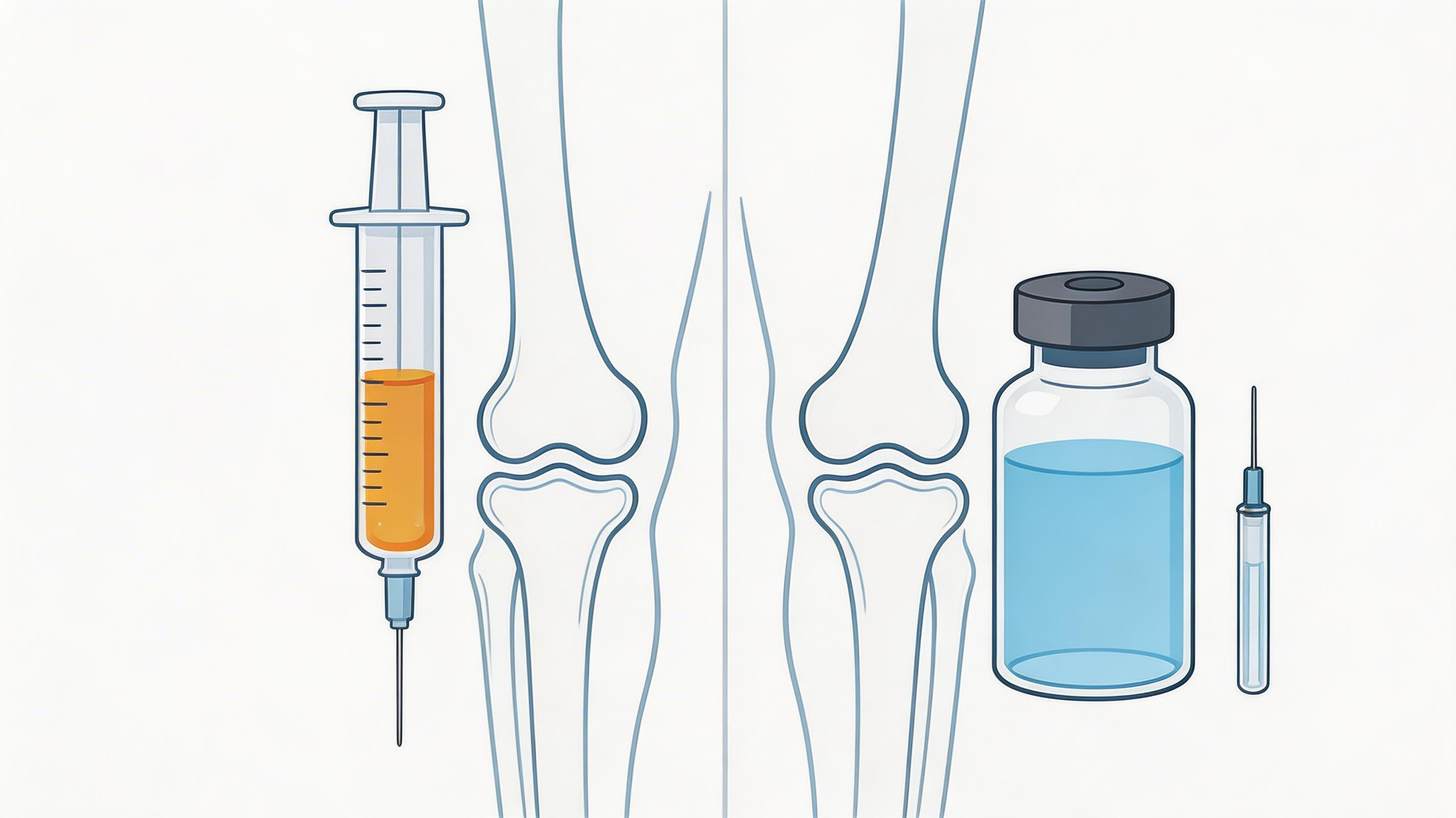
    Comparing PRP and hyaluronic acid injections for joint pain treatment
    Comparing PRP and hyaluronic acid injections for joint pain treatment

    How Do PRP and Hyaluronic Acid Work?

    Platelet-rich plasma (PRP) is made from your own blood. A sample is drawn, centrifuged to concentrate platelets, and injected back into the affected joint or tissue. Platelets release growth factors that reduce inflammation and stimulate tissue repair. The effect is biological and regenerative.
    Hyaluronic acid (HA) is a synthetic version of a substance your joints naturally produce. It acts as a lubricant and shock absorber. Injecting HA supplements the joint's natural fluid, reduces friction, and can decrease pain. It does not repair tissue — it provides mechanical cushioning. HA injections go by brand names like Synvisc, Euflexxa, Gel-One, and Orthovisc.
    The key difference: PRP targets the biological source of pain and degeneration. HA addresses the mechanical environment. This distinction matters for choosing the right treatment.

    Which Is More Effective? What the Research Shows

    Multiple head-to-head randomized controlled trials have compared PRP and HA for knee osteoarthritis. The balance of evidence favors PRP, especially at longer follow-up periods.
    A 2017 meta-analysis in the American Journal of Sports Medicine1 pooling data from 10 randomized trials found PRP produced significantly greater pain reduction and functional improvement than HA at both 6 and 12 months. The advantage for PRP was more pronounced at 12 months, suggesting that PRP's benefits grow over time while HA's fade.
    A cost-effectiveness analysis in Arthroscopy2 also found PRP was more cost-effective than HA over a 2-year horizon, generating more quality-adjusted life years at a lower incremental cost per year of benefit.
    That said, HA is not without merit. Some patients do not respond to PRP or prefer the faster initial relief that HA can provide. Individual response varies, and no single treatment works for everyone.
    FactorPRPHyaluronic Acid
    MechanismBiological: growth factors, tissue repairMechanical: joint lubrication
    Onset of benefit4 – 8 weeks2 – 4 weeks
    Duration of results12 – 24 months4 – 6 months (typical)
    Insurance coverageUsually not coveredPartially covered for knee OA
    Cost per injection$700 – $1,400$300 – $700
    Number of injections1 – 3 (once)1 – 5 (often repeated)
    Evidence for knee OAStrong (Level I RCTs)Moderate (mixed results)
    Side effectsMild soreness 1–3 daysMild soreness, rare pseudo-sepsis

    Cost Comparison: PRP vs Hyaluronic Acid

    PRP typically costs $700 to $1,400 per injection. A full 3-injection course runs $2,100 to $4,200. See our full breakdown in our PRP cost guide.
    Hyaluronic acid runs $300 to $700 per injection. Some HA protocols require 3 to 5 weekly injections, bringing the full course cost to $900 to $3,500. The cost difference shrinks when you compare full treatment courses.
    Critically, many insurance plans cover HA injections for knee osteoarthritis (though some have narrowed this coverage in recent years), while PRP is almost universally excluded. Out-of-pocket, HA is cheaper upfront. But if PRP results last twice as long, the annual cost per year of relief may favor PRP over repeated HA courses.

    Which Should You Choose?

    Your choice depends on several factors:
    Choose PRP if: You have early to moderate knee osteoarthritis or chronic tendinopathy, you want the longest possible duration of relief, you are willing to pay out of pocket, and you prefer a biologically active treatment that targets the source of degeneration.
    Choose HA if: Your insurance covers it and cost is a primary concern, you have tried PRP without adequate response, you want faster initial relief, or your physician believes your joint mechanics would benefit more from lubrication than biological signaling.
    Some physicians use PRP and HA together in staged protocols — starting with PRP for its regenerative effect, then adding HA for lubrication. Evidence for this combination approach is still early. A consultation with an orthopedic specialist or sports medicine physician who offers both treatments will give you the clearest guidance for your specific case.

    Frequently Asked Questions

    Not Sure Which Injection Is Right for You?

    Talk to a specialist who can compare your options and recommend the best treatment for your specific condition.

    Find a PRP Specialist

    Sources

    1. Shen L, Yuan T, Chen S, et al. The temporal effect of platelet-rich plasma on pain and physical function in the treatment of knee osteoarthritis: systematic review and meta-analysis. J Orthop Surg Res. 2017;12(1):16. PubMed
    2. Belk JW, Kraeutler MJ, Houck DA, et al. What Is the Appropriate Price for Platelet-Rich Plasma Injections for Knee Osteoarthritis? Arthroscopy. 2020;36(5):1397–1403. PubMed

    Related Articles

    Back to the Trails: A Runner's PRP Success Story

    How one marathon runner returned to competition after PRP treatment for plantar fasciitis.

    Does Insurance Cover PRP Injections? What Patients Need to Know

    Most insurance plans don't cover PRP therapy yet. Learn why, which exceptions exist, and how to use HSA/FSA funds or financing to manage the cost.

    How Long Do PRP Injections Last? What the Research Shows

    PRP results can last 6 months to 2+ years depending on the condition and patient. Here's what clinical research says about PRP longevity and when to repeat treatment.

    How Many PRP Injections Do You Need? A Treatment Planning Guide

    Most patients need 1 to 3 PRP injections. Learn the standard treatment protocols by condition, what affects how many shots you need, and when to consider a second course.

    How Much Does PRP Therapy Cost? A Complete 2026 Guide

    Wondering what PRP therapy costs in 2026? Learn average prices by treatment area, what drives the cost, and how to make PRP affordable without insurance.

    My PRP Journey: From Chronic Pain to Active Living

    One patient shares their experience with PRP treatment for a rotator cuff injury.

    New Research Shows PRP Effective for Knee Osteoarthritis

    A comprehensive meta-analysis reveals promising outcomes for patients with moderate knee arthritis.

    Preparing for Your First PRP Injection

    Tips and guidelines to help you prepare for a successful PRP treatment session.

    PRP as an Alternative to Joint Replacement Surgery: Who Qualifies?

    Can PRP therapy help you avoid knee or hip replacement? Learn who qualifies for PRP as an alternative to surgery, what the evidence shows, and when surgery becomes necessary.

    PRP Injection Recovery: What to Expect in the Days and Weeks After

    What should you expect after a PRP injection? Here's a complete recovery timeline covering pain, activity restrictions, and tips that speed healing.

    Find a Specialist

    Connect with board-certified providers offering PRP therapy.