PRP Therapy as an Alternative to Knee Replacement Surgery
Learn how PRP therapy can delay or prevent knee replacement surgery. Evidence-based guide covering clinical research, costs, candidacy, and outcomes.
April 2, 2026
Knee replacement surgery helps hundreds of thousands of people each year. But it is major surgery with a long recovery, real risks, and a price tag that can exceed $50,000. If you have knee osteoarthritis and want to exhaust every option before going under the knife, platelet-rich plasma (PRP) therapy may buy you significant time or even help you avoid the operating room altogether.
This guide breaks down what the clinical evidence says about PRP injections as a knee replacement alternative, who qualifies, how the two approaches compare on cost and recovery, and when surgery is still the right call.
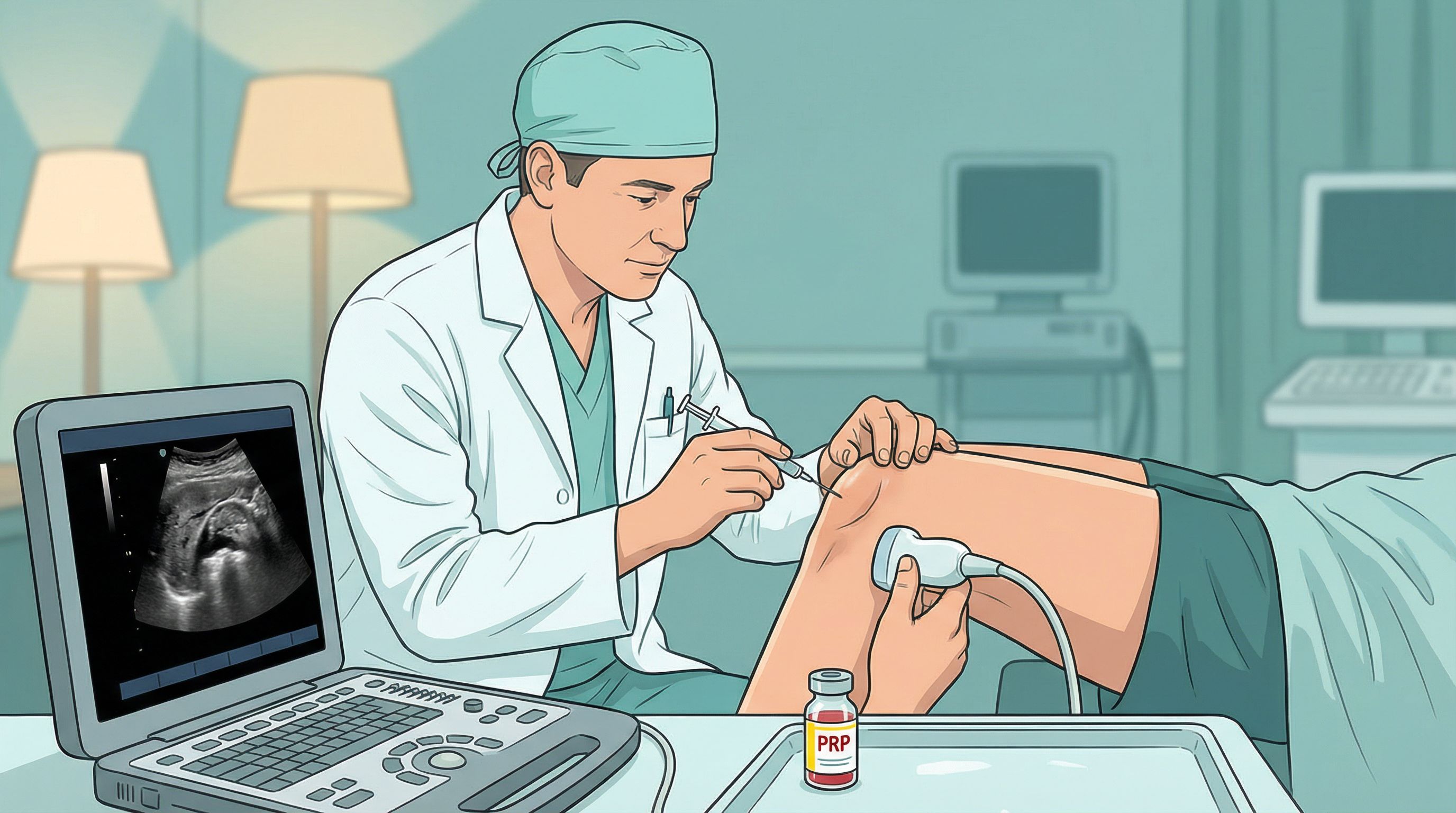
PRP therapy delivers concentrated growth factors directly into the knee joint, offering a non-surgical alternative to knee replacement.
Why Patients Look for Alternatives to Knee Replacement
The American Academy of Orthopaedic Surgeons (AAOS) estimates that roughly 700,000 total knee replacements are performed in the United States each year. That number has been climbing steadily, and projections suggest it could exceed 3.48 million annually by 2030.1
Total knee arthroplasty (TKA) is effective. Success rates exceed 85%, and modern implants last 15 to 20 years in most patients.2 But there are good reasons to delay or avoid it when possible.
Recovery takes 3 to 6 months before patients return to normal daily activities, and full recovery often takes a year. The surgery carries a complication rate of roughly 5%, including risks of infection (under 2%), blood clots, stiffness, and implant loosening.2 For younger patients, early knee replacement also raises the likelihood of needing a second, more complex revision surgery later in life.
Then there is the cost. According to Cleveland Clinic data, the average total knee replacement costs between $35,000 and $75,000 when you include hospitalization, anesthesia, implant costs, and rehabilitation.3
These factors explain why more patients and orthopedic specialists are exploring biological treatments like PRP to manage knee osteoarthritis before committing to joint replacement.
What Is PRP and How Does It Work for Knee Osteoarthritis?
Platelet-rich plasma is a concentrated preparation drawn from your own blood. A small sample is taken, placed in a centrifuge to separate the components, and the platelet-rich layer is extracted and injected directly into the knee joint.
Platelets contain growth factors that play a role in tissue repair and inflammation control. When injected into an osteoarthritic knee, PRP delivers a concentrated dose of these growth factors, including platelet-derived growth factor (PDGF), transforming growth factor beta (TGF-B), and vascular endothelial growth factor (VEGF).
The proposed mechanisms include reducing inflammation within the joint, stimulating cartilage cell activity, improving the quality of synovial fluid, and slowing the progression of cartilage breakdown. A comprehensive review published in the Journal of Clinical Medicine details these mechanisms and the preparation protocols used in modern PRP therapy.4
What the Research Says: Can PRP Delay or Prevent Knee Replacement?
The most compelling evidence for PRP as a knee replacement alternative comes from a landmark retrospective study published in International Orthopaedics. Sanchez et al. analyzed 667 knee osteoarthritis patients who received PRP injections and found that 74.1% achieved a delay in total knee arthroplasty of more than 1.5 years, with a median delay of 5.3 years. Their survival analysis showed that 85.7% of patients did not undergo knee replacement during the five-year follow-up period.5
Disease severity, patient age, the number of PRP treatment cycles, and the administration route all had a statistically significant influence on outcomes.
Multiple head-to-head comparisons have evaluated PRP against hyaluronic acid (HA), the other major injectable option for knee osteoarthritis.
A 2026 systematic review and meta-analysis by Centeno et al. in International Orthopaedics found that PRP was superior to both hyaluronic acid and corticosteroids for knee osteoarthritis outcomes. The analysis included data drawn from multiple randomized controlled trials and confirmed PRP's advantage in pain reduction and functional improvement at 6 and 12 months.7
Xu et al. published a 2026 systematic review in the Journal of Orthopaedic Surgery and Research examining leukocyte-rich versus leukocyte-poor PRP formulations against hyaluronic acid. Both PRP types outperformed HA, though leukocyte-poor PRP showed a slightly better safety profile.8
Corticosteroid injections remain the most commonly prescribed injection for knee osteoarthritis, but their benefits are short-lived and repeated use may accelerate cartilage loss.
Bains et al. published a 2025 prospective, double-blind randomized controlled trial in The Journal of Arthroplasty comparing PRP to corticosteroid injections. While corticosteroids provided superior short-term pain relief in the first few weeks, PRP demonstrated better outcomes at the 6-month and 12-month marks.9
A 2026 safety comparison by Bensa et al. in Knee Surgery, Sports Traumatology, Arthroscopy evaluated complication profiles across intra-articular corticosteroids, hyaluronic acid, PRP, and cell-based injections. PRP showed a favorable safety profile, with lower rates of adverse events than corticosteroids.10
A Cleveland Clinic analysis evaluated whether PRP injections represent a cost-effective alternative to knee replacement for treating osteoarthritis. The analysis found that for patients who can delay or avoid surgery through PRP treatment, the total cost savings are substantial, especially when factoring in avoided hospitalization, rehabilitation, and lost work time.11
A typical PRP treatment course costs between $500 and $2,500 per injection, with most protocols recommending a series of 1 to 3 injections. Even with repeated annual treatments, the cumulative cost over several years is a fraction of what a single knee replacement costs. Learn more about PRP injection costs.
Who Is a Good Candidate for PRP Instead of Knee Replacement?
PRP therapy works best for a specific patient profile. You may be a strong candidate if you meet several of the following criteria:
You have mild to moderate knee osteoarthritis, classified as Kellgren-Lawrence grade I through III. You still have some healthy cartilage remaining in the joint. Your pain limits daily activities but has not reached the point where you cannot walk or sleep. You have tried and exhausted conservative treatments like physical therapy, weight management, and oral anti-inflammatory medications. You want to delay surgery, especially if you are younger than 60 and want to avoid a future revision.
PRP is less likely to help in these situations: You have severe, bone-on-bone osteoarthritis (Kellgren-Lawrence grade IV) with complete cartilage loss. You have significant joint deformity or mechanical malalignment. Your knee instability stems from ligament damage rather than arthritis alone.
The research from Sanchez et al. confirmed that disease severity is the strongest predictor of whether PRP can meaningfully delay knee replacement.5 The earlier you explore PRP in the disease process, the better your chances of a good outcome.
Comparing PRP therapy with total knee replacement for knee osteoarthritis treatment.
PRP vs. Knee Replacement: A Side-by-Side Comparison
Factor
PRP Therapy
Total Knee Replacement
<b>Procedure</b>
In-office injection, 30 to 60 minutes
Major surgery, 1 to 2 hours, general anesthesia
<b>Recovery</b>
1 to 2 days of mild soreness; normal activity within a week
3 to 6 months; full recovery up to 1 year
<b>Cost</b>
$500 to $2,500 per injection
$35,000 to $75,000
<b>Insurance</b>
Rarely covered
Typically covered by insurance
<b>Risk of complications</b>
Minimal (injection site soreness, rare infection)
5% complication rate including infection, blood clots, stiffness
<b>Durability</b>
6 to 12 months per treatment cycle; repeatable
15 to 20 years per implant
<b>Best for</b>
Mild to moderate OA (KL grade I to III)
Severe OA (KL grade III to IV) with failed conservative care
<b>Anesthesia</b>
None or local
General or spinal
What to Expect from PRP Treatment for Your Knee
The PRP process is straightforward. Your doctor draws a small blood sample, typically 30 to 60 mL. The blood is processed in a centrifuge for 10 to 15 minutes to concentrate the platelets. The PRP is then injected into the knee joint, often guided by ultrasound for precision.
Most patients experience mild soreness and swelling at the injection site for 2 to 3 days. Doctors typically recommend avoiding anti-inflammatory medications (like ibuprofen) for a week before and after treatment, since these can interfere with the platelet signaling that drives the healing response.
Improvement is not immediate. Most patients begin to notice reduced pain and better function within 4 to 6 weeks after injection, with peak benefits at 3 to 6 months. Many treatment protocols recommend a series of 2 to 3 injections spaced 2 to 4 weeks apart, followed by annual maintenance injections if the initial response is positive.
PRP is not a universal solution. Knee replacement remains the gold standard for patients who have exhausted all conservative and biological treatments without adequate relief.
Surgery is typically the best path when you have severe, end-stage osteoarthritis with complete cartilage loss, when pain and disability significantly limit your quality of life despite other treatments, when joint deformity is progressing and affecting your ability to walk, or when you have already tried PRP or other injections without meaningful improvement.
The decision between PRP and surgery should be made in partnership with an orthopedic specialist who can evaluate your imaging, functional status, and treatment history. It does not have to be one or the other. Many patients use PRP to manage their knee osteoarthritis for years before eventually proceeding to knee replacement when the disease has progressed beyond what biological treatments can address.
Finding a PRP Provider Near You
If you are considering PRP therapy as an alternative to knee replacement, the first step is consulting with a qualified provider who specializes in regenerative orthopedic treatments. Look for providers who use ultrasound-guided injections, follow evidence-based preparation protocols, and have experience treating knee osteoarthritis specifically.
You can search our directory of PRP providers by state to find a specialist in your area.
The Bottom Line
PRP therapy offers a legitimate, evidence-backed option for patients with mild to moderate knee osteoarthritis who want to delay or potentially avoid knee replacement surgery. The research shows that PRP can reduce pain, improve function, and push back the timeline for surgery by years in appropriately selected patients.
It is not a cure for osteoarthritis, and it will not reverse severe joint damage. But for the right patient at the right stage of disease, PRP represents a lower-risk, lower-cost treatment that preserves your natural knee and keeps surgical options open for the future.
Talk to a qualified orthopedic specialist about whether PRP is a reasonable next step for your knee. The earlier in the disease process you explore biological treatments, the more options you have.
Sources
1. Sloan M, Premkumar A, Sheth NP. Projected volume of primary total joint arthroplasty in the U.S., 2014 to 2030. J Bone Joint Surg Am. 2018;100(17):1455-1460. doi:10.2106/JBJS.17.01617
2. American Academy of Orthopaedic Surgeons. Total knee replacement. OrthoInfo. Accessed April 1, 2026. https://orthoinfo.aaos.org/en/treatment/total-knee-replacement/
3. Cleveland Clinic. Knee replacement (arthroplasty): what it is and recovery time. Cleveland Clinic. Accessed April 1, 2026. https://my.clevelandclinic.org/health/treatments/8512-knee-replacement
4. Platelet-rich plasma for knee osteoarthritis: a comprehensive narrative review of the mechanisms, preparation protocols, and clinical evidence. J Clin Med. 2025;14(11):3983. doi:10.3390/jcm14113983
5. Sanchez M, Delgado D, Sanchez P, et al. Platelet-rich plasma injections delay the need for knee arthroplasty: a retrospective study and survival analysis. Int Orthop. 2021;45(2):401-410. doi:10.1007/s00264-020-04669-9
6. Platelet rich plasma injections for knee osteoarthritis: an overview of systematic reviews. Front Physiol. 2025. doi:10.3389/fphys.2025.1598514
7. Centeno CJ, et al. Autologous platelet-rich plasma versus hyaluronic acid, corticosteroids or saline for knee osteoarthritis: can blood draw volume predict outcomes? Int Orthop. 2026. doi:10.1007/s00264-026-06782-7
8. Xu et al. Leukocyte-rich versus leukocyte-poor platelet-rich plasma and hyaluronic acid for knee osteoarthritis: a systematic review and meta-analysis. J Orthop Surg Res. 2026. doi:10.1186/s13018-026-06689-4
9. Bains S, et al. Platelet-rich plasma injections are inferior to corticosteroid injections for short-term pain relief: a prospective, double-blind randomized controlled trial. J Arthroplasty. 2025. doi:10.1016/j.arth.2025.03.013
10. Bensa A, et al. Safety profile comparison of intra-articular corticosteroids, hyaluronic acid, platelet-rich plasma, and cell-based injections for knee osteoarthritis. Knee Surg Sports Traumatol Arthrosc. 2026. doi:10.1002/ksa.70230
11. Cleveland Clinic. Analysis: are platelet-rich plasma injections a cost-effective alternative to knee replacement for treating osteoarthritis? ConsultQD. Accessed April 1, 2026. https://consultqd.clevelandclinic.org/analysis-are-platelet-rich-plasma-injections-a-cost-effective-alternative-to-knee-replacement-for-treating-osteoarthritis
Find a PRP Specialist Near You
Search our verified directory of orthopedic PRP providers who specialize in regenerative treatments.