PRP Therapy as an Alternative to Rotator Cuff Surgery
Explore how PRP injections can treat rotator cuff tears without surgery. Research-backed guide on outcomes, candidacy, and costs.
April 2, 2026
Rotator cuff tears affect roughly 22% of the general population, and that number climbs sharply with age. When physical therapy, rest, and anti-inflammatory medications fail to resolve the pain, the next conversation usually centers on surgery. But rotator cuff repair carries real risks, a long recovery, and retear rates that remain stubbornly high. Platelet-rich plasma (PRP) therapy has emerged as a viable nonsurgical option for many patients, especially those with partial-thickness tears or chronic tendinopathy.
This guide covers what the latest research says about PRP for rotator cuff tears, who benefits most from PRP over surgery, and how the two approaches compare head-to-head.
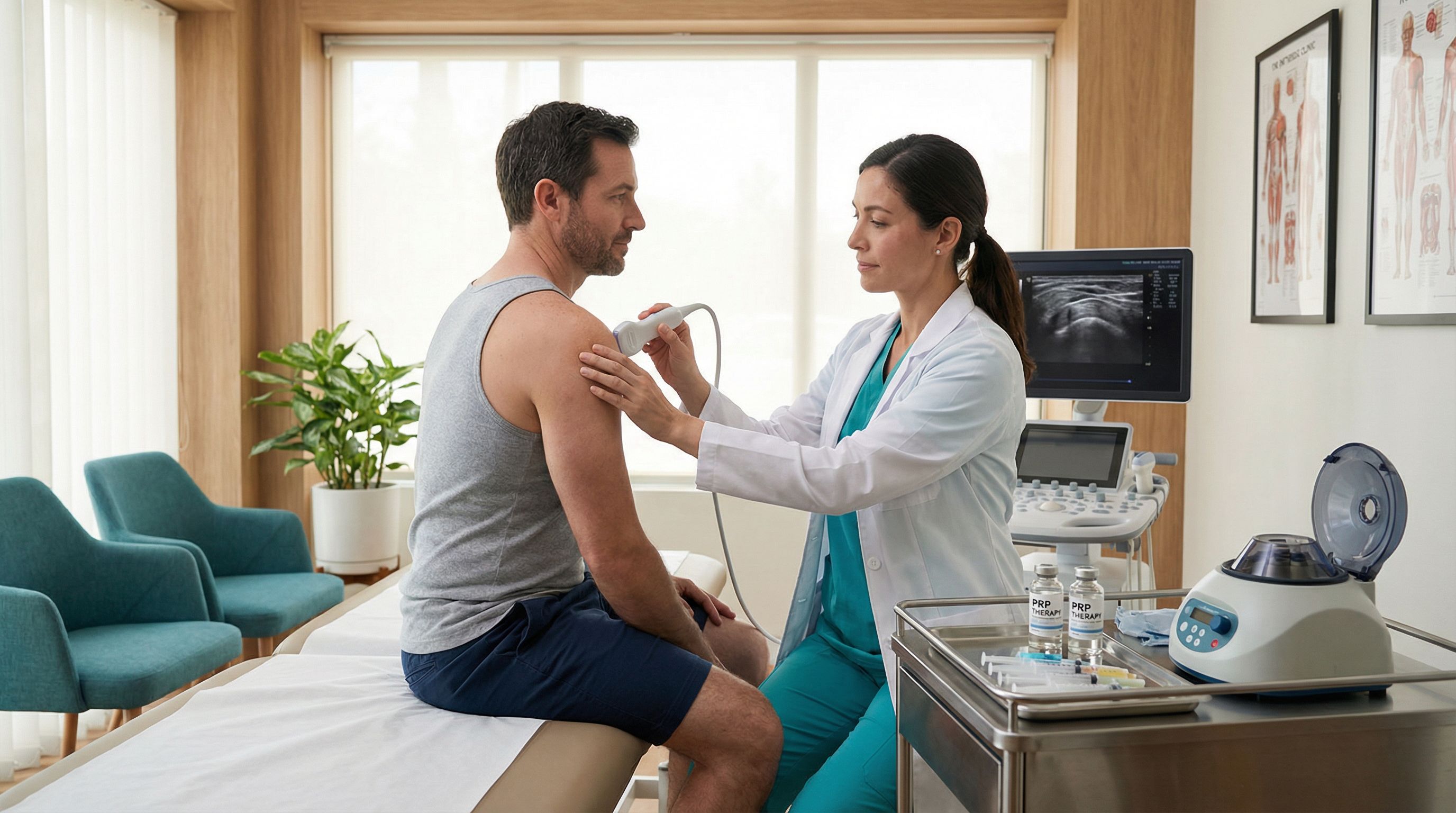
PRP therapy targets the damaged rotator cuff tendon with concentrated growth factors to promote healing without surgery.
Why Patients Seek Alternatives to Rotator Cuff Surgery
More than 400,000 rotator cuff repairs are performed in the United States each year, with an average surgical cost exceeding $11,000 for the procedure alone.1 When you factor in anesthesia, facility fees, and postoperative rehabilitation, the total cost often ranges from $20,000 to $50,000.
Recovery is demanding. A national claims database analysis found that the typical recovery period following rotator cuff repair is approximately 153 days, or about five months.1 That timeline assumes no complications. Patients who develop postoperative stiffness or adhesive capsulitis face recoveries nearly three times longer and costs that nearly double.1
Perhaps most concerning, retear rates remain high. Published data shows retear rates between 10% and 40% depending on tear size and repair technique.2 A study in Arthroscopy reported that rotator cuff repairs fail at an alarmingly high rate during the first two years, and roughly 8.7% of patients require additional surgery.1
These realities make a strong case for exploring biological treatments like PRP before committing to an operation, particularly for patients with smaller tears, chronic tendinopathy, or risk factors that predict poor surgical outcomes.
How PRP Works for Rotator Cuff Injuries
Platelet-rich plasma is prepared by drawing a small blood sample, processing it in a centrifuge to concentrate the platelets, and injecting the resulting preparation directly into or around the damaged tendon under ultrasound guidance.
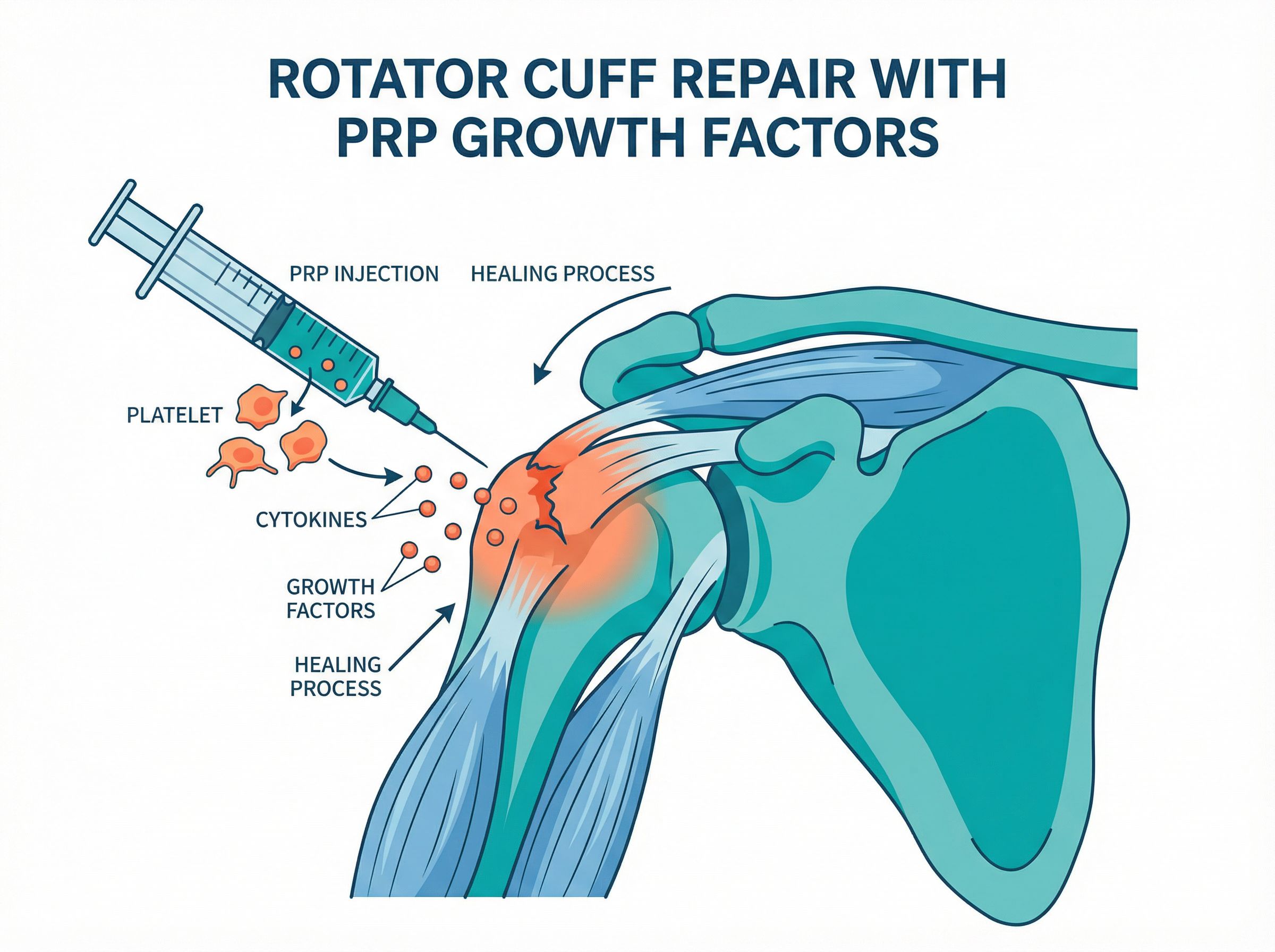
Platelets release growth factors that play a role in tendon repair, including platelet-derived growth factor (PDGF), transforming growth factor beta (TGF-B), and insulin-like growth factor (IGF-1). For rotator cuff injuries specifically, these growth factors aim to reduce inflammation in the subacromial space, stimulate tendon cell proliferation and collagen production, improve the local healing environment around the damaged tendon, and slow or halt the progression from a partial tear to a full tear.
The distinction between leukocyte-rich and leukocyte-poor PRP formulations matters here. Recent evidence suggests that leukocyte-poor PRP (LP-PRP) may be the better choice for rotator cuff applications, both as a standalone injection and as a surgical adjunct.3
What the Research Says: PRP for Rotator Cuff Tears
The evidence base for PRP in rotator cuff management has grown substantially, with multiple systematic reviews and meta-analyses published in 2024 through 2026.
Pain Relief and Functional Improvement
A large systematic review and meta-analysis published in Cureus in 2025 synthesized 36 randomized controlled trials involving approximately 2,000 patients with rotator cuff tears. PRP produced significant short-term pain relief, with lower VAS pain scores at six weeks, three months, six months, and one year compared with controls (all P < 0.05). Functional scores (ASES and Constant-Murley) also improved during the first three to six months, though long-term functional gains were inconsistent across trials.4
PRP vs. Corticosteroid Injections
A 2024 double-blind randomized controlled trial by Rossi et al. in the Journal of Shoulder and Elbow Surgery compared a single PRP injection against a single corticosteroid injection in 100 patients with rotator cuff tendinopathy. At 12 months, PRP showed significantly greater improvement across every outcome measured: lower VAS pain scores (1.68 vs. 2.3, P < .001), higher ASES scores (89.8 vs. 78.0, P < .001), and higher SANE scores (89.2 vs. 80.5, P < .001). The failure rate was also significantly lower in the PRP group: 12% versus 30% for corticosteroids (P < .01).5
This is a critical finding. Corticosteroid injections remain the most commonly prescribed injectable for rotator cuff pain, but they provide only short-term relief and may weaken tendon tissue with repeated use. PRP offers a longer-lasting benefit without that risk. For more on this comparison, see our guide on PRP vs. cortisone injections.
PRP as a Nonsurgical Treatment for Partial Tears and Tendinopathy
A 2026 retrospective study by Brilakis et al. in Knee Surgery, Sports Traumatology, Arthroscopy followed 47 patients with chronic rotator cuff tendinopathy or partial-thickness tears who received ultrasound-guided leukocyte-poor PRP injections. At a mean follow-up of 47 months (nearly four years), patients showed dramatic improvements: ASES scores rose from 39.7 to 95.6 and SANE scores from 43.4 to 92.2, both surpassing the minimum clinically important difference. Post-injection median VAS pain scores were 0 at rest, at night, and during movement.6
These medium-term results are particularly encouraging because they suggest PRP is not just a short-term fix. The sustained improvement at nearly four years supports PRP as a durable nonsurgical option for the right patients.
Reducing Retear Rates When Surgery Is Needed
Even when surgery is the right choice, PRP may play a valuable role as a surgical adjunct. A 2025 meta-analysis by Hovland et al. in Arthroscopy analyzed 9 RCTs involving 743 patients and found that leukocyte-poor PRP reduced retear rates by 46% compared with controls (risk ratio 0.54, P < .00001). VAS pain scores and functional outcomes (ASES, Constant, UCLA) were also significantly improved.3
A separate 2025 meta-analysis by Gill et al. in Musculoskeletal Surgery confirmed these findings: PRP reduced retear rates at 24 months with a mean risk reduction of 15.03%, along with significant improvements in VAS scores at both 6 and 12 months post-repair.2
PRP for Calcific Tendinopathy
A 2025 network meta-analysis by Moggio et al. in Orthopaedic Surgery compared multiple conservative treatments for rotator cuff calcific tendinopathy and found that PRP had the highest probability (85%) of improving shoulder function among all interventions studied, including extracorporeal shockwave therapy, needle aspiration, and other injectable treatments.7
PRP growth factors stimulate tendon cell proliferation and collagen production in the damaged rotator cuff.
Who Is a Good Candidate for PRP Instead of Rotator Cuff Surgery?
PRP is most likely to succeed as a surgery alternative in the following scenarios:
You have a partial-thickness rotator cuff tear (less than 50% of tendon thickness involved). You have chronic rotator cuff tendinopathy with pain but no full-thickness tear on MRI. You have failed conservative treatment (physical therapy, NSAIDs, activity modification) but the tear has not progressed. You are over 60 and the primary goal is pain relief and functional maintenance rather than returning to overhead athletics. You have medical conditions (diabetes, obesity, cardiovascular disease) that increase surgical complication risk and recovery time.1
PRP is less likely to replace surgery when you have a full-thickness rotator cuff tear, especially a large or massive tear. You are a younger athlete who needs to return to overhead sports at a high level. You have significant shoulder weakness that limits daily function. You have a traumatic acute tear rather than a degenerative process.
A 2026 systematic review by Trygonis et al. in the Journal of Orthopaedics confirmed that conservative management (including PRP) is a clinically effective and cost-efficient first-line approach for degenerative rotator cuff tears, particularly for partial tears and elderly patients. However, surgical repair remained associated with superior long-term functional outcomes in full-thickness tears.8
PRP vs. Rotator Cuff Surgery: A Side-by-Side Comparison
Factor
PRP Therapy
Rotator Cuff Surgery
<b>Procedure</b>
In-office injection, 30 to 45 minutes, ultrasound-guided
Arthroscopic or open surgery, 1 to 3 hours, general anesthesia
<b>Recovery</b>
1 to 2 days of soreness; return to activity within 1 to 2 weeks
4 to 6 months; sling for 4 to 6 weeks; full recovery up to 1 year
Partial tears, tendinopathy, degenerative tears in older patients
Full-thickness tears, traumatic tears, young athletes
<b>Anesthesia</b>
None or local
General or regional
What to Expect from PRP Treatment for Your Shoulder
The procedure begins with a blood draw, typically 30 to 60 mL. The sample is processed in a centrifuge for 10 to 15 minutes. The resulting PRP concentrate is then injected into the subacromial space or directly into the tendon under ultrasound guidance for precision.
Most treatment protocols use leukocyte-poor PRP for rotator cuff applications, based on the latest evidence showing better outcomes with this formulation.3 Your provider may recommend a single injection or a series of 2 to 3 injections spaced several weeks apart.
Expect mild soreness and swelling at the injection site for 2 to 3 days. Avoid anti-inflammatory medications (ibuprofen, naproxen) for at least one week before and after treatment, as these can interfere with the platelet-mediated healing response.
Improvement develops gradually. Most patients notice meaningful pain reduction within 4 to 6 weeks, with peak benefits at 3 to 6 months. The Brilakis study showed sustained improvement at nearly four years, suggesting the effects can be long-lasting in responsive patients.6
When Rotator Cuff Surgery Is Still the Right Choice
PRP has limitations, and surgery remains the standard of care for certain rotator cuff injuries.
Surgery is typically the best path when you have a full-thickness tear that is progressing in size on serial imaging, when significant weakness prevents you from performing daily tasks like reaching overhead or lifting, when a traumatic acute tear occurs in an otherwise healthy tendon (sports injury, fall), or when you have tried PRP and physical therapy without adequate improvement.
The decision should be made collaboratively with an orthopedic specialist who can assess your tear type, size, and location on MRI alongside your functional goals and overall health. Many patients use PRP to manage symptoms for months or years before eventually proceeding to surgery if and when the tear progresses.
Finding a Shoulder PRP Provider
If you are considering PRP for a rotator cuff injury, look for a provider who uses ultrasound-guided injection technique, prepares leukocyte-poor PRP (based on current evidence), and has specific experience treating shoulder conditions with PRP.
PRP therapy offers a meaningful nonsurgical alternative for patients with partial rotator cuff tears, chronic tendinopathy, and degenerative cuff disease. The evidence shows significant pain relief, improved function, lower failure rates than corticosteroid injections, and sustained benefits at medium-term follow-up. When used as a surgical adjunct, PRP also reduces retear rates by nearly half.
PRP will not replace surgery for large, full-thickness tears or acute traumatic injuries. But for the many patients with smaller tears, tendinopathy, or elevated surgical risk, it represents a lower-cost, lower-risk treatment that can meaningfully improve quality of life and potentially delay or eliminate the need for surgery.
Sources
1. Cost drivers and delays in recovery following rotator cuff repair: insights from a national claims database. J Med Econ. 2025. doi:10.1080/13696998.2025.2563465
2. Gill SS, Shukla A, Godhamgaonkar A, Namireddy SR. Evaluating the longitudinal efficacy of platelet-rich plasma in rotator cuff surgery: a systematic review and meta-analysis. Musculoskelet Surg. 2025;110(1):41-61. doi:10.1007/s12306-025-00906-9
3. Hovland S, Amin V, Liu J, Aceto M, Wright V. Perioperative leukocyte-poor platelet-rich plasma associated with reduced risk of retear after arthroscopic rotator cuff repairs: a systematic review and meta-analysis of randomized controlled trials. Arthroscopy. 2025;41(11):4762-4771. doi:10.1016/j.arthro.2025.05.015
4. Rout S, Rout S. The effectiveness of platelet-rich plasma in the management of rotator cuff tears: a systematic review and meta-analysis. Cureus. 2025;17(11):e98132. doi:10.7759/cureus.98132
5. Rossi LA, Brandariz R, Gorodischer T, et al. Subacromial injection of platelet-rich plasma provides greater improvement in pain and functional outcomes compared to corticosteroids at 1-year follow-up: a double-blinded randomized controlled trial. J Shoulder Elbow Surg. 2024;33(12):2563-2571. doi:10.1016/j.jse.2024.06.012
6. Brilakis E, Ioannidis K, Roumeliotis L, et al. Peritendinous leucocyte-poor platelet-rich plasma injections improve symptomatic chronic rotator cuff tendinopathies and partial-thickness rotator cuff tears: a retrospective study with medium-term follow-up. Knee Surg Sports Traumatol Arthrosc. 2026;34(4):1414-1420. doi:10.1002/ksa.70272
7. Moggio L, Marotta N, de Sire A, et al. Efficacy of conservative approaches on pain relief and function in patients with rotator cuff calcific tendinopathy: which is the best option? A systematic review and network meta-analysis. Orthop Surg. 2025;17(11):3048-3066. doi:10.1111/os.70175
8. Trygonis N, Loupasis T, Hautz WE, Exadaktylos AK. Conservative management of degenerative rotator cuff tears: a systematic review of long-term clinical outcomes and cost effectiveness. J Orthop. 2026;75:232-241. doi:10.1016/j.jor.2026.02.040
Find a PRP Specialist Near You
Search our verified directory of orthopedic PRP providers who specialize in regenerative treatments.