Discover how PRP injections can treat disc degeneration, herniated discs, and chronic back pain without surgery. Evidence-based guide.
April 2, 2026
Back surgery is one of the most common and costly procedures in the United States, yet outcomes are far from guaranteed. Failed back surgery syndrome affects a significant percentage of patients, and spinal fusion alone carries a reoperation rate above 11%. For patients with disc-related low back pain, herniated discs, or radicular pain, platelet-rich plasma (PRP) injections are emerging as a legitimate nonsurgical option that can reduce pain, restore function, and potentially eliminate the need for an operation altogether.
This guide covers what the clinical evidence says about PRP for spine conditions, who is a good candidate, and how PRP compares to common back surgeries on cost, recovery, and outcomes.
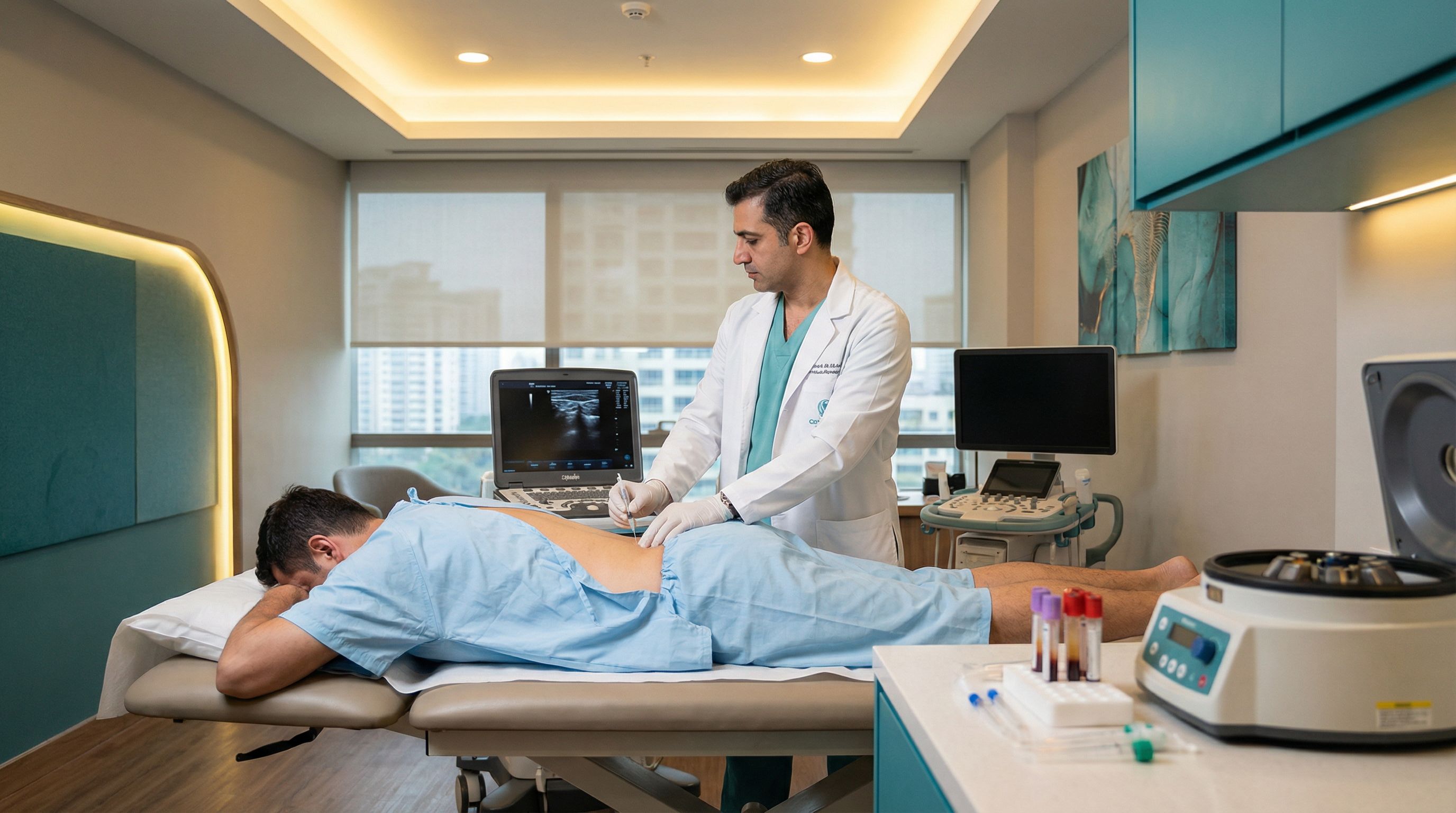
PRP therapy offers a non-surgical approach to treating disc degeneration and chronic back pain.
The Problem with Back Surgery
Spinal fusion is the workhorse of back surgery, accounting for over 455,500 procedures per year in the United States at an aggregate hospital cost of $14.1 billion.1 When you factor in surgeon fees, anesthesia, implants, facility charges, and rehabilitation, a single spinal fusion can cost between $80,000 and $150,000.1
Recovery is demanding. Most patients face 3 to 6 months before returning to normal daily activities, with full recovery often taking a year or longer. During this time, many patients need physical therapy, pain management, bracing, and follow-up imaging.
But the real concern is reliability. A 2025 retrospective claims analysis found that within two years of surgery, 11.0% of lumbar fusion patients required reoperation, 5.6% experienced pseudarthrosis (failed fusion), and 4.3% developed an infection.2 Within 90 days alone, 12.0% of patients experienced a complication, with 7.8% classified as serious.2
Even discectomy and laminectomy, which are less invasive than fusion, carry meaningful complication and recurrence rates. Disc herniation recurs in roughly 5% to 15% of patients after discectomy, often requiring a second surgery.
These realities explain why more spine specialists are exploring biological treatments like PRP for patients whose pain stems from disc degeneration, disc herniation, or facet joint dysfunction.
How PRP Works for Spine Conditions
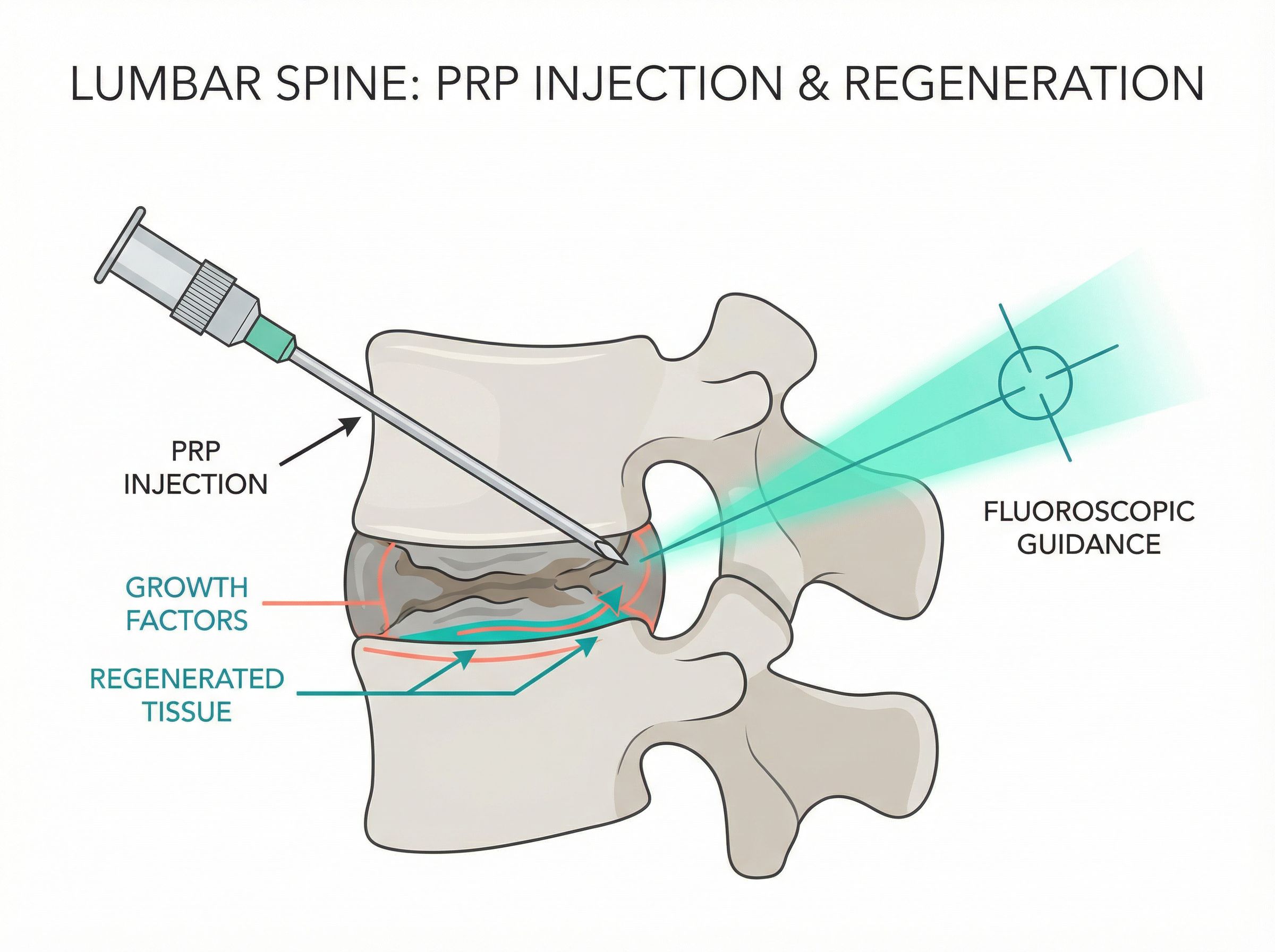
Platelet-rich plasma is prepared from a small blood draw, concentrated in a centrifuge, and injected directly into the affected spinal structure under fluoroscopic or CT guidance. For spine applications, PRP can be delivered through several routes depending on the pain source.
Intradiscal injection targets the disc itself and is used for discogenic low back pain caused by internal disc disruption or early degenerative disc disease. PRP growth factors aim to reduce inflammation within the disc, stimulate repair of the annular wall, and slow the progression of degeneration.
Epidural injection delivers PRP into the epidural space around the spinal nerves and is used for disc herniations causing radicular pain (sciatica). This approach targets the inflammatory cascade around compressed nerve roots.
Facet joint injection targets the facet joints and surrounding ligaments, which are a common source of axial low back pain, especially in older patients. Learn more about PRP for facet joint syndrome.
A 2025 review in Pain Physician described a "functional spinal unit" approach to orthobiologic injections, where PRP is delivered to multiple pain-generating structures (disc, facet, ligament) in a single treatment session for more comprehensive relief.3
What the Research Says: PRP for Back Pain and Disc Disease
The evidence base for spinal PRP has grown rapidly, with several key studies published in 2024 and 2025.
PRP Epidural Injections vs. Steroid Epidurals
A 2025 meta-analysis by Ermawan et al. in Spine Surgery and Related Research compared epidural PRP to epidural steroid injections across three randomized controlled trials (132 patients) for prolapsed lumbar discs. At one month, steroids provided better pain relief. But at six months, PRP demonstrated significantly greater pain reduction (mean difference -1.51, P < .00001) and lower disability scores on the Oswestry Disability Index (mean difference -9.71, P = .006). Critically, the steroid group showed significant worsening of pain scores between months 1 and 6, while PRP patients continued to improve.4
A larger 2025 systematic review and meta-analysis by Wang et al. in the Journal of Orthopaedic Surgery and Research confirmed these findings, concluding that PRP offered comparable short-term relief and superior long-term outcomes compared to corticosteroid injections for lumbar radicular pain.5
A 2025 prospective randomized controlled trial by Wang et al. in Frontiers in Pain Research compared intradiscal PRP to methylene blue injection in 40 patients with discogenic low back pain. Both groups improved, but PRP demonstrated meaningful pain reduction and functional improvement that held at follow-up.6
A long-term retrospective study by Anitua et al. in Pain and Therapy followed patients who received intradiscal and epidural PRP (specifically, plasma rich in growth factors) for chronic back pain. The study demonstrated sustained efficacy over an extended follow-up period, supporting PRP as a durable treatment rather than a temporary fix.7
Pauza et al. published 1-, 2-, and 3-year follow-up data in Pain Physician on intra-annular fibrin (a PRP-derived preparation) for chronic discogenic low back pain and radiculopathy. The results showed lasting improvement across all time points, offering some of the longest follow-up data available for intradiscal biologics.8
Two 2025 systematic reviews and meta-analyses published in Frontiers in Surgery and Frontiers in Pharmacology evaluated PRP injection combined with percutaneous endoscopic lumbar discectomy (PELD) for disc herniations. Both found that adding PRP to the minimally invasive procedure significantly reduced recurrence rates and improved clinical outcomes compared to PELD alone.9
This is particularly relevant for patients who do need some form of intervention beyond injection alone. Even in a surgical context, PRP adds value by promoting disc healing and reducing the likelihood of reherniation.
PRP for Chronic Low Back Pain
A 2023 systematic review published in Biomedicines evaluated PRP across multiple spinal applications and categorized the overall level of evidence as Level II. The review found that PRP provided modest but clinically significant improvements in pain and disability, with a favorable safety profile compared to corticosteroid injections.10
Intradiscal PRP injection targets the degenerative disc directly under fluoroscopic guidance.
Who Is a Good Candidate for PRP Instead of Back Surgery?
PRP therapy for the spine works best in specific clinical scenarios:
You have discogenic low back pain confirmed by provocative discography or MRI showing disc degeneration (Pfirrmann grades III to IV) without severe structural collapse. You have a contained disc herniation causing radicular pain that has not responded to physical therapy and oral medications but does not yet require emergency surgery. You have facet joint pain or sacroiliac joint dysfunction contributing to chronic low back pain. You want to avoid or delay spinal fusion, particularly if you are concerned about adjacent segment disease or the long recovery timeline. You have already had back surgery and are experiencing recurrent pain (failed back surgery syndrome) where additional surgery carries diminishing returns.
PRP is less likely to replace surgery in these situations: You have severe spinal stenosis causing neurogenic claudication or significant nerve compression. You have cauda equina syndrome or progressive neurological deficits requiring urgent decompression. You have spinal instability (spondylolisthesis grade II or higher) that requires structural stabilization. You have a large extruded or sequestered disc fragment compressing a nerve root.
PRP vs. Back Surgery: A Side-by-Side Comparison
Factor
PRP Therapy
Spinal Fusion / Discectomy
<b>Procedure</b>
Image-guided injection, 30 to 60 minutes
Major surgery, 2 to 5 hours, general anesthesia
<b>Recovery</b>
1 to 3 days of soreness; normal activity within 1 to 2 weeks
3 to 12 months; significant activity restrictions
<b>Cost</b>
$1,000 to $3,000 per session
$80,000 to $150,000 (fusion); $20,000 to $50,000 (discectomy)
<b>Insurance</b>
Rarely covered
Typically covered
<b>Reoperation rate</b>
Repeatable as needed; no structural risk
11% reoperation within 2 years (fusion)
<b>Complication risk</b>
Minimal (injection site soreness, rare discitis)
12% complication rate within 90 days; infection 4.3%
<b>Best for</b>
Discogenic pain, contained herniations, facet pain, early degeneration
Severe stenosis, instability, large extrusions, failed conservative care
<b>Anesthesia</b>
Local with sedation option
General
What to Expect from Spinal PRP Treatment
The procedure varies based on the injection target. For intradiscal PRP, you will lie face down on a procedure table. Using fluoroscopic (live X-ray) guidance, the physician places a needle into the center of the affected disc and injects the PRP preparation. For epidural PRP, the technique is similar to a standard epidural steroid injection but uses PRP instead of corticosteroid.
Most patients experience mild soreness at the injection site for 1 to 3 days. A temporary increase in back pain for the first week is common with intradiscal injections as the PRP initiates its inflammatory healing response. This is expected and typically resolves within 7 to 10 days.
Avoid anti-inflammatory medications (ibuprofen, naproxen) for at least one week before and after treatment. These medications suppress the platelet signaling that drives the healing process.
Improvement is gradual. Most patients begin to notice reduced pain within 4 to 8 weeks, with continued improvement over 3 to 6 months. The Ermawan meta-analysis showed that PRP patients continued improving between months 1 and 6, while steroid patients worsened during that same window.4
Some protocols recommend a series of 2 to 3 injections, while others use a single treatment with follow-up as needed. Your provider will tailor the approach based on your specific diagnosis and response.
PRP has real limitations for spine conditions. Surgery remains essential in several scenarios.
Cauda equina syndrome, where compression of the nerve bundle at the base of the spine causes bowel or bladder dysfunction, requires emergency surgical decompression. Progressive neurological deficits, such as worsening leg weakness or foot drop, typically warrant surgical intervention. Significant spinal instability from spondylolisthesis or fracture needs structural stabilization that injections cannot provide. Severe spinal stenosis with debilitating symptoms that have not responded to conservative care may require decompression surgery.
The decision between PRP and surgery should involve a thorough evaluation by a spine specialist who can review your MRI findings, neurological exam, and treatment history. Many patients benefit from trying PRP first, reserving surgery for cases where biological treatment fails to provide adequate relief.
Finding a Spine PRP Provider
If you are considering PRP for back pain, choose a provider who has specific experience with spinal PRP applications, uses fluoroscopic or CT guidance for precise needle placement, and can assess whether your pain is discogenic, facet-mediated, or radicular to determine the optimal injection approach.
PRP therapy offers a growing body of evidence as a nonsurgical treatment for disc-related low back pain, herniated discs, and radicular pain. The research shows that epidural PRP outperforms steroid injections at six months and beyond, intradiscal PRP provides lasting relief for degenerative disc disease, and PRP combined with minimally invasive procedures reduces recurrence rates.
PRP will not replace surgery for severe spinal stenosis, instability, or neurological emergencies. But for the many patients with discogenic pain, contained herniations, or facet joint dysfunction, PRP represents a dramatically lower-cost, lower-risk option that preserves spinal anatomy and avoids the lengthy recovery and significant complication rates associated with back surgery.
Sources
1. Hospital-level variation in hospitalization costs for spinal fusion in the United States. PLoS One. 2024;19(2):e0298135. doi:10.1371/journal.pone.0298135
2. Health care outcomes and costs associated with cervical and lumbar spinal fusion surgeries in the United States: a retrospective claims database study. J Spinal Disord Tech. 2025. doi:10.1097/bsd.0000000000001880
3. Navani A, et al. Functional spinal unit approach for orthobiologic injections for low back pain. Pain Physician. 2025.
4. Ermawan R, et al. Epidural platelet-rich plasma long-term outcome is better than steroid for prolapsed lumbar intervertebral discs: a meta-analysis of randomized controlled trials. Spine Surg Relat Res. 2025. doi:10.22603/ssrr.2025-0007
5. Wang Y, et al. Therapeutic interventions of platelet-rich plasma versus corticosteroid injections for lumbar radicular pain: a systematic review and meta-analysis. J Orthop Surg Res. 2025. doi:10.1186/s13018-025-05725-z
6. Wang Y, et al. Platelet-rich plasma for the treatment of discogenic low back pain: a prospective randomized controlled trial. Front Pain Res. 2025. doi:10.3389/fpain.2025.1648772
7. Anitua E, et al. A long-term retrospective observational clinical study evaluating the efficacy of plasma rich in growth factors (PRGF) in the treatment of back pain. Pain Ther. 2025. doi:10.1007/s40122-024-00699-y
8. Pauza KJ, et al. Long-term investigation of annulargrams and intra-annular fibrin to treat chronic discogenic low back pain and radiculopathy: 1-, 2-, and 3-year follow-up. Pain Physician. 2024.
9. The clinical efficacy of percutaneous endoscopic lumbar discectomy combined with platelet-rich plasma injection for lumbar disc herniation: a systematic review and meta-analysis. Front Surg. 2025. doi:10.3389/fsurg.2025.1601772
10. Systematic review of platelet-rich plasma for low back pain. Biomedicines. 2023;11(9):2404. doi:10.3390/biomedicines11092404
Find a PRP Specialist Near You
Search our verified directory of orthopedic PRP providers who specialize in regenerative treatments.